
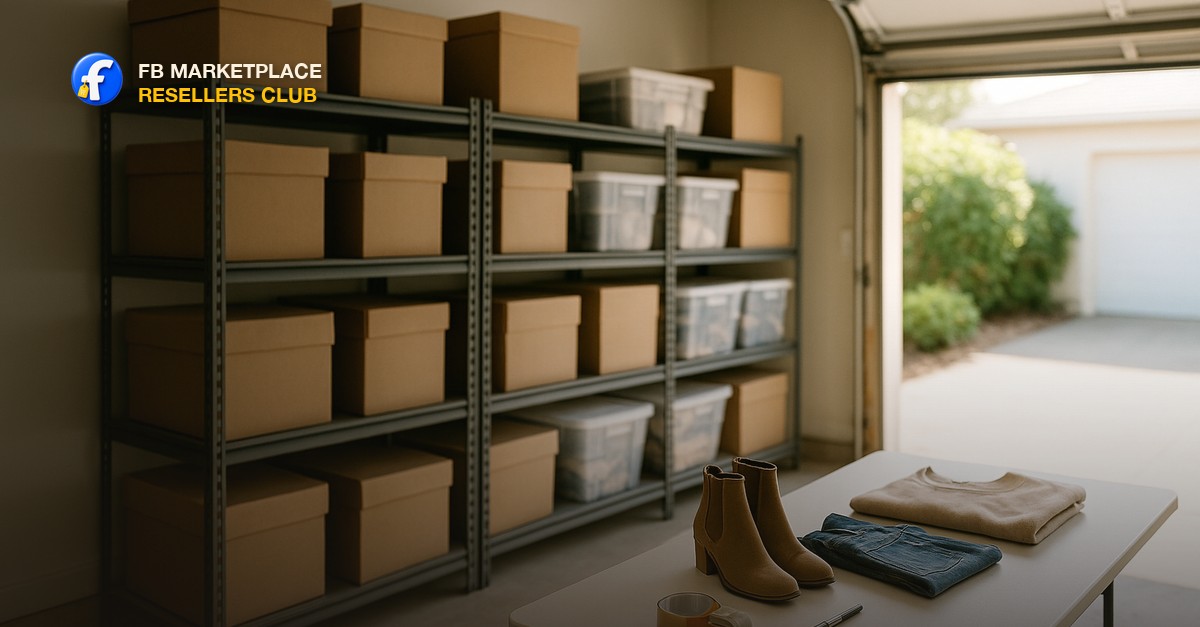
How to store and organize Facebook Marketplace inventory
Give every item a fixed home the moment it enters your space, and label that home with a number that also goes on the listing. A pegged number system beats a memory system every time: small items go in numbered clear bins, medium items get a numbered shelf spot, and furniture gets a marked wall or corner. When an item sells, you read the number off the listing, walk straight to that spot, and grab it. No digging, no guessing, no telling a buyer you need an extra day because you cannot find the thing you already sold them.
That is the whole system in one paragraph. The rest of this post is how to set it up cheaply, what to actually store items in, how to track cost and age without a complicated app, and how to keep the pile from growing faster than you sell. Storage is one of the most ignored parts of flipping, and it is the exact thing that turns a profitable side hustle into a house full of stuff and a partner who is done with it.
Why inventory organization is a profit problem, not a tidiness problem
Disorganized inventory costs you real money, not just peace of mind. When you cannot find a sold item fast, you make buyers wait, and a buyer who waits is a buyer who ghosts and leaves you a lower response rating. When you do not know what you paid for something, you cannot price it for a real margin or know if a flip actually made money. And when items are buried, they age past the season or the trend that made them worth flipping, and you end up dumping them at a loss.
- Lost items mean canceled sales, refunds, and a slipping seller rating - all of which cost more than the shelf would have.
- Not tracking buy price means you are guessing at margin, and guessing usually means underpricing the good flips and overpricing the slow ones.
- Buried inventory ages out of its window, so a seasonal or trend item that would have sold in a week sits until it is worth half.
- A house overrun with flips is the number one reason resellers quit, more than any pricing or sourcing problem.
So the goal is not a magazine-clean garage. The goal is that every item can be found in under a minute, every item has a known cost, and nothing sits so long you forget you own it. A tidy space is the side effect, not the point.
The Numbered Home system
The Numbered Home system is the club's approach to inventory: every item gets one fixed, numbered storage location, and that number is written directly into the listing. It works because it removes memory from the process entirely. You are not trying to recall where you put a lamp three weeks ago. You read the number off the sold listing and walk to it.
- Number your storage, not your items. Label bins and shelf spots 1, 2, 3 and so on with tape and a marker. The location is permanent even though what lives there changes.
- When an item comes in, put it in an open numbered spot and write that number somewhere only you see it - the end of the listing description works, or a private note field.
- When it sells, the listing tells you the location. Grab it, ship or hand it off, and that number is now free for the next item.
- Keep the log in sync: the same number appears on the item's row in your tracker, so location, cost, and listing all point at each other.
The trick that makes this stick is hiding the location code in plain sight on the listing itself. A short tag like a bracketed number at the very end of the description is invisible to buyers who skim and instantly meaningful to you. You never have to keep a separate map of where things are, because the listing you are already looking at when it sells is the map.
What to store your inventory in
Match the container to the item, and buy the cheapest option that protects the flip. You are storing things to sell them, not to keep them forever, so the storage should cost far less than the margin it protects. Start with what you already own and only buy bins and shelving once the volume justifies it.
Storage matched to item type
| Item type | Store it in | Why |
|---|---|---|
| Small goods, electronics, decor | Clear stackable bins with lids, numbered | You can see contents at a glance and stack them to save floor space |
| Clothing and soft goods | Bins or hanging rack, kept dry and off the floor | Damp or crushed clothing loses value fast, so airflow and shape matter |
| Medium items, small appliances, tools | Numbered metal or wire shelving | Open shelves hold weight, resist damp, and let you read labels from across the room |
| Furniture and large items | A marked wall or corner, off the ground on a pallet or blanket | Keeps legs and finishes off a damp floor and stops stacking damage |
| Fragile items | Bins with packing paper, stored where nothing stacks on top | The cost of a broken flip is the whole item, so protection here pays for itself |
Whatever you use, keep inventory off concrete floors and out of direct damp. A cheap wire shelf or a couple of pallets solves most moisture and pest problems that quietly eat into flips stored in a garage or basement. If an item photographs and lists well but shows up to the buyer musty or scuffed from bad storage, you have turned a good flip into a return.
The one-line inventory log that tracks your real margin
A simple spreadsheet with one row per item is enough to run this whole business, and it is where organization turns into knowing your actual profit. You do not need reseller software until you are moving serious volume. What you need is to know, for every item, what you paid, where it lives, when you listed it, and what it sold for.
The columns that matter
| Column | What it tells you |
|---|---|
| Item | A short description so you can scan the sheet fast |
| Location # | The numbered home, matching the bin or shelf and the listing tag |
| Buy price | Your true cost basis, so margin is a fact not a guess |
| List date | How long it has been sitting, which flags stale inventory |
| Sell price | What it actually went for, so you learn which flips are worth repeating |
Fill in the buy price and location the day an item comes in, and the sell price the day it leaves. Once a month, sort by list date and look at anything that has been sitting more than a few weeks. That aging column is the early-warning system that tells you to drop a price or relist before an item is a dead loss. Knowing your true buy price is also the foundation of pricing everything else, which is covered in [how to price a flip using comps](/blog/how-to-price-items-facebook-marketplace).
Keeping inventory from taking over your home
Set a hard space cap and treat it as full. The most common way flipping goes wrong is not a bad sale, it is buying faster than you sell until the inventory owns the garage, the spare room, and the goodwill of everyone you live with. A fixed cap forces the discipline that keeps this a business instead of a collection.
- Decide your space limit up front - a set number of shelves and bins, or one specific room or corner. When it is full, you stop sourcing until you sell something.
- Adopt a one-in-one-out rhythm once you are at capacity. A new item only comes in when a sold one goes out, which keeps your money working instead of sitting on a shelf.
- Run a monthly stale sweep. Anything past its list-date window gets a price drop or a relist, and anything truly dead gets bundled or donated so it stops taking a numbered home a live flip could use.
- Do not let a storage unit be your first fix. Rent is a monthly cost against your margin, and most resellers do not need one until their home space is genuinely maxed and their volume clearly pays for it.
The stale sweep is where storage discipline meets your listings. An item that has aged out is usually a visibility or price problem, not a storage one, and the fix is to relist or drop rather than to buy more shelving. When you do need to grow, the space cap and the log tell you exactly when, which plugs straight into [how to scale your Facebook Marketplace business](/blog/how-to-scale-your-facebook-marketplace-business).
Short, practical drops on sourcing, pricing with comps, listing copy, and safe meetups. No spam, unsubscribe anytime.
Frequently asked questions
How should a beginner organize Facebook Marketplace inventory?
Start with a numbered storage system before you buy any software or shelving. Label a few bins and shelf spots with numbers, and when an item comes in, put it in an open spot and write that number at the end of the listing description. Keep a one-line log per item with the description, location number, buy price, and list date. That is enough to find any sold item in seconds and know your real margin. Add more bins or a shelf only when your volume actually needs it.
What is the best thing to store reselling inventory in?
Match the container to the item. Clear stackable bins are best for small goods, electronics, and decor because you can see the contents and stack to save floor space. Numbered wire or metal shelving works for medium items, tools, and small appliances. Furniture should sit off the floor on a pallet or blanket against a marked wall. The main rule is to keep everything off bare concrete and out of damp, since moisture and stacking damage quietly turn good flips into returns.
Do I need a storage unit for flipping on Facebook Marketplace?
Most resellers do not, at least not early on. A storage unit is a monthly cost that eats directly into your margin, so it only makes sense once your home space is genuinely full and your volume clearly pays for the rent. Before renting one, set a hard space cap at home, adopt a one-in-one-out rhythm, and run a monthly sweep to clear stale inventory. Usually that frees enough room to keep going without paying for outside storage.
How do I track what I paid for inventory?
Use a simple spreadsheet with one row per item and fill in the buy price the day it comes in. Include columns for a short description, the storage location number, the buy price, the list date, and the sell price. This gives you your true cost basis so margin is a fact rather than a guess, and the list-date column flags items that have been sitting too long. It also makes tax time far easier, since your income and cost records are already in one place.
How do I stop my flips from taking over the house?
Set a fixed space cap and treat it as full when you hit it. Decide up front how many bins and shelves, or which room or corner, your inventory is allowed to occupy. Once it is full, stop sourcing until you sell something, then move to a one-in-one-out rhythm so money keeps working instead of sitting on a shelf. Run a monthly sweep to price-drop, relist, or clear anything that has aged out so dead items are not holding space a live flip could use.
Should I keep items in their original boxes?
Keep the original box only when it genuinely adds value, such as for electronics, collectibles, or anything a buyer expects boxed. Original packaging can raise the sale price and make shipping safer for those items. For everything else, boxes just eat storage space, so break them down or recycle them and store the item in a numbered bin instead. Let the resale value of the packaging, not habit, decide whether the box earns its shelf space.
Last reviewed by Nicole on September 16, 2026