
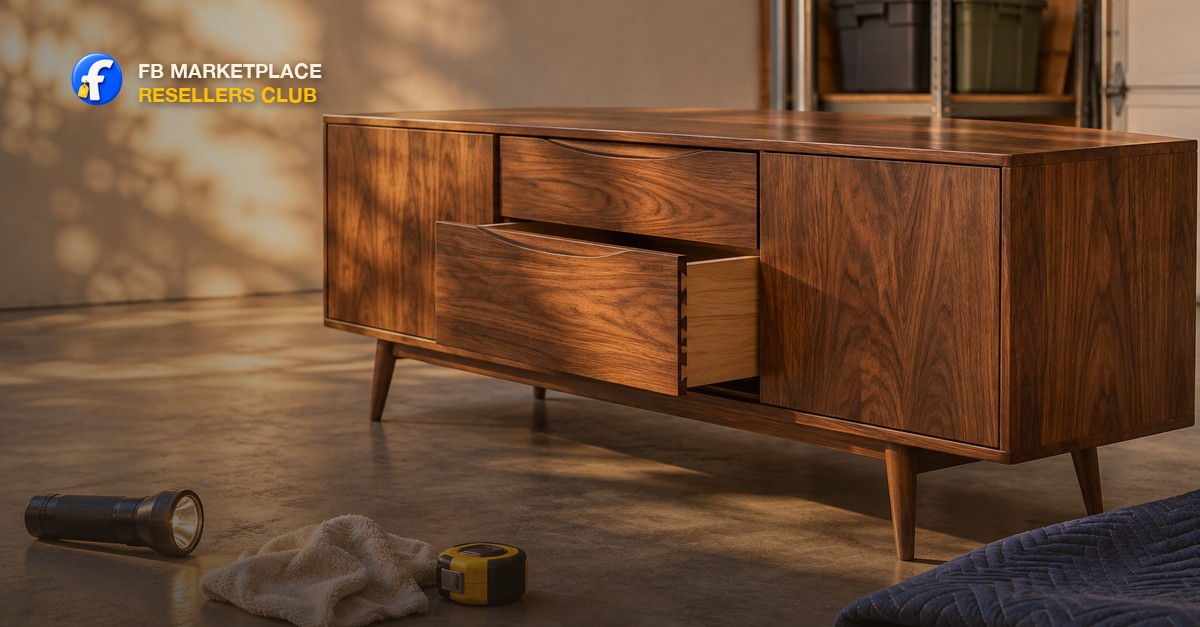
How to flip mid-century modern furniture on Facebook Marketplace: the short answer
To flip mid-century modern furniture on Facebook Marketplace, buy genuine vintage pieces from sellers who are clearing out a home or who list them as plain 'old dresser' or 'wood table,' run the Mark-Joint-Surface check before you pay, clean and condition the wood instead of stripping it, then list it with the maker, the era, the measurements and photos that show the lines of the piece. Skip new pieces sold as 'mid-century style' at vintage prices, veneer that is lifting in big sections, and anything with water damage or structural cracks you cannot fix well.
If you have read the guides on how to flip furniture, how to flip dressers or how to flip dining tables on Facebook Marketplace, the basic habits carry over: inspect before you pay, price off what similar pieces actually sold for near you, and make the piece look like it belongs in a real room. What is different with mid-century modern is that the style itself is the selling point, so the buyer cares whether it is the real thing. Knowing how to tell is where your margin comes from.
What counts as mid-century modern
Mid-century modern describes design from roughly 1945 to 1970, built around clean, simple lines and very little decoration. In furniture, that usually looks like tapered or splayed legs, low and long case pieces, simple pulls or recessed finger pulls, and warm woods such as walnut and teak, often as veneer over a solid core. The style came back strongly from the late 1990s on, and it has stayed popular since.
That popularity is the opportunity and the trap. Because people want the look, plenty of furniture made in recent years copies it. Those pieces can be nice and they can flip too, but they are used modern furniture, and they should be bought and priced like used modern furniture, not like vintage.
Mid-century modern pieces you will see most on Marketplace
| Piece | What to look at first |
|---|---|
| Credenzas, sideboards and buffets | Drawer construction, sliding doors that run smoothly, and the top surface, which takes the most wear |
| Dressers and highboys | Every drawer slides and closes flush, the case does not rack side to side, and the pulls are all there |
| Nightstands and end tables | Often sold in pairs, and a matched pair is worth more than two singles. Check for water rings on the top |
| Coffee tables | Veneer edges and corners, where it chips and lifts first, and whether the legs are tight |
| Dining tables and chairs | Wobble in the chairs, cracked joints, and whether leaves for the table are included |
| Lounge chairs and sofas | Frame joints and upholstery condition. Reupholstering is expensive, so judge the fabric as it is |
The Mark-Joint-Surface check
The Mark-Joint-Surface check is how I recommend vetting a mid-century piece before money changes hands. Mark tells you who made it and when. Joint tells you how it was built, which is your best clue to whether it is old and well made. Surface tells you how much work stands between you and a listing. A piece does not need to pass all three perfectly, but you should know where it stands on each before you agree on a number.
- Mark. Bring a flashlight and look inside the top drawer, on the back panel, underneath the piece and on the inside of doors for a stamp, a burned-in logo, a paper label or a metal tag. A maker's name gives you real sold comps and a stronger title. On many vintage Lane pieces, the number stamped on the piece is a date code you read backwards, which lets you tell the buyer roughly when it was made. If there is no mark, the piece can still be real and still be a good flip, but price it off the build and the look, not off a famous name you are hoping it is.
- Joint. Pull a drawer all the way out. Look at the front corners for dovetail joints, the interlocking cuts that join the drawer front to the sides. Look at the bottom of the drawer and the back of the case: real wood or plywood, held with screws, is a good sign, while particleboard, staples and cardboard-like backs usually mean a newer or cheaper piece. Slotted screws, rather than the cross-head screws on most new furniture, point toward an older piece. Push on the top corners of the case to see if it racks.
- Surface. Look across the top in raking light from your flashlight. Light scratches, dull finish and small marks often improve a lot with cleaning and conditioning. Watch for white or dark water rings, sun fading on one side, burns, and veneer that is chipped, bubbled or lifting at the edges. Press gently on any bubble: if it moves, the glue under it has failed.
What to fix and what to leave alone
In my view, the biggest mistake new flippers make with mid-century pieces is doing too much. A lot of buyers want original finish and original hardware, and much of this furniture uses veneer, which is a thin layer of wood. Sand too hard and you go straight through it, and a piece that only needed a clean now needs a patch you cannot hide.
Common mid-century problems, sorted by how worried to be
| Problem | How to think about it |
|---|---|
| Dust, grime and a dull finish | Usually just a gentle clean and a wood conditioner. This is where a lot of the margin is |
| Light surface scratches | Often fade with cleaning and conditioning. Test any product on a hidden spot first |
| Sticky or stiff drawers | Often old dirt on the runners. Clean them and try a little paraffin wax before assuming anything is broken |
| Missing or mismatched pulls | Original pulls matter to buyers. Replacing one odd pull is a small job. Swapping all of them with new hardware can lower the appeal |
| Loose chair or table joints | Fixable if you know how to reglue a joint properly. Do not just drive in new screws |
| Small veneer chips at the edges | Can be repaired by someone who knows veneer. Disclose it either way |
| Large lifting or missing veneer, water damage, cracked legs | In my view, usually a pass unless you already restore furniture. These are slow, skilled repairs |
| Smoke or musty smell inside drawers | Drawers can sometimes be aired out, but upholstered pieces with smell are usually a pass |
Photograph the piece before you touch it. Before-and-after photos help you decide whether the work was worth your time, and some buyers like seeing them.
Where to find mid-century modern furniture to flip
- Marketplace itself: set saved searches for 'mid century,' 'MCM,' 'teak,' 'walnut dresser,' 'credenza,' 'vintage nightstands' and the maker names you learn. Also search plain terms like 'old dresser' and 'wood dresser,' because the best buys are often listed by people who do not know the style name.
- Estate sales: homes that have not been redecorated in decades are where a lot of genuine pieces come from. The estate sale sourcing guide on this blog covers how to work them.
- Moving and downsizing listings: a seller with a move-out date usually cares more about the piece being gone than about its exact value.
- Thrift stores and garage sales: check furniture often, and look underneath anything with tapered legs. The thrift store and garage sale sourcing guides cover routes and timing.
Before any pickup, follow the safe meetup checklist in the Guides section. Large case pieces are heavy and you will often be inside someone's home, so agree on the time and who is helping carry before you show up. Bring moving blankets so tapered legs and veneer edges do not get chipped in your vehicle.
How to list mid-century furniture so it sells
Mid-century buyers search by style, maker and piece, and they want to know if it is the real thing, what shape it is in and whether it fits their space. Answer all of that in the listing.
- Title: maker if known, then 'mid century modern' or 'MCM,' then the wood and the piece. For example: 'Lane Mid Century Modern Walnut Nightstand' or 'MCM Teak 6-Drawer Dresser, Dovetail Drawers.' The post on listing titles that get clicks has more examples.
- Photos: straight on from the front, a low angle that shows the legs and the profile, a close-up of the wood grain, the maker's mark, an open drawer showing the joints, and every flaw. The photo staging basics post covers lighting and backgrounds.
- Specs: width, depth and height, and drawer count. Mid-century case pieces are often long and low, so buyers need the numbers to know if it fits under a TV or window.
- Description: maker and approximate era if you could verify them, what you cleaned or repaired, original finish and hardware or not, and any flaws. Only say what you actually know. If you could not find a mark, say 'no maker's mark found' rather than guessing a name.
- Delivery: many buyers do not have a truck. If you can deliver, say so and say what it costs. The guide on how to offer delivery on Facebook Marketplace covers pricing it.
Price off sold comps for the same maker and piece near you, then run the numbers through the flip profit calculator with cleaning supplies, any hardware or repair, gas and your time included. In my view, the maker's mark photo and the open-drawer photo do more to sell a real mid-century piece than anything else, because they answer the question every serious buyer has: is this actually vintage?
Common mistakes when flipping mid-century modern furniture
- Paying vintage money for a new 'mid-century style' piece.
- Calling something by a famous maker or designer name without a mark to back it up.
- Sanding or stripping veneer instead of cleaning it first.
- Replacing original hardware that buyers would have wanted to keep.
- Skipping the look inside the drawers and at the back of the case.
- Splitting up a matching pair or set you could have sold together.
- Leaving measurements out of the listing.
- Chipping legs and edges because you moved it without blankets.
One thing you can do this week
Set saved searches for 'mid century,' 'MCM' and 'old dresser,' then open ten listings and note for each one whether the photos show a maker's mark, the inside of a drawer or the back of the piece. Message two sellers and ask for a photo of the inside of a drawer and any stamp or label, even if you do not buy, so checking the mark and the joints becomes a habit before your first pickup.
Short, practical drops on sourcing, pricing with comps, listing copy, and safe meetups. No spam, unsubscribe anytime.
Frequently asked questions
Is flipping mid-century modern furniture on Facebook Marketplace worth it?
It can be, when you buy a genuine piece cheap from someone who does not know what it is or needs it gone, it passes the Mark-Joint-Surface check and it mostly needs cleaning rather than restoration. Sold comps for the same maker and piece near you should clear your price after supplies, gas and your time.
How can I tell if furniture is real mid-century modern?
Look for a maker's mark or label inside drawers, on the back or underneath. Pull a drawer and check for dovetail joints and real wood or plywood construction. Slotted screws and solid construction point toward an older piece, while stapled particleboard and thin fiber backs usually mean newer furniture made in the style.
What years is mid-century modern furniture from?
Mid-century modern generally covers design from roughly 1945 to 1970. Many pieces sold as mid-century today are newer furniture made in the same style, so check the build and any marks before paying a vintage price.
How do I read a Lane furniture date code?
On many vintage Lane pieces, the number stamped on the piece is a date code you read backwards. Reverse the digits and split them into month, day and year. Look inside a drawer, on the back panel or underneath to find it.
Should I refinish mid-century furniture before flipping it?
Usually not as a first step. Much mid-century furniture uses thin veneer that is easy to sand through, and many buyers want the original finish. Clean and condition first, and only refinish when the surface damage is too much to sell around and you know how to work with veneer.
What should I put in a mid-century furniture listing?
The maker if known, 'mid century modern' or 'MCM,' the wood and the piece in the title, plus measurements, photos of the maker's mark, an open drawer, the legs and every flaw, what you cleaned or repaired, and whether you deliver.
Last reviewed by Nicole on November 19, 2026