
How to offer delivery on Facebook Marketplace
Turn on door dropoff in the listing's meetup preferences so buyers know delivery is possible, then write one line in the description saying delivery is available for an extra fee quoted by distance. When a buyer asks, get their cross streets and the access details before you quote. Price the delivery separately from the item, take payment on arrival or a deposit up front, and put in writing exactly where you will set the item down. Never fold delivery into the item price as a closing sweetener.
That last sentence is the whole post. Almost every seller who says delivery is not worth it made the same mistake: they agreed a price, then the buyer asked can you drop it off, and saying yes cost them an hour of driving and a tank of fuel out of a margin that was already set. Delivery is not a concession. It is a second product you sell alongside the first one, and it has its own cost and its own price.
Delivery is not shipping, and Marketplace treats them differently
Marketplace supports two formal fulfilment paths and one informal one. Shipping runs through Facebook's checkout with a prepaid label, and buyer protection applies to those eligible checkout orders. Local pickup happens off-platform in cash or whatever the two of you agree. Local delivery, where you drive the item to the buyer, is not a product Facebook builds, prices, or protects. It is a private arrangement in Messenger.
The three ways an item can reach a Marketplace buyer
| Path | Who handles it | What you need to know |
|---|---|---|
| Shipping via checkout | Facebook, with a prepaid label | Payment runs through the platform and buyer protection covers eligible checkout orders. Best for small, light, brand-name items |
| Local pickup | The buyer, at a meetup or your door | Off-platform payment, no platform protection, no transport cost to you |
| Local delivery | You, arranged in Messenger | Facebook does not calculate or collect a delivery fee. You quote it, you collect it, you carry the risk |
Because the platform does not price delivery for you, nothing stops a buyer from treating it as free. Your listing has to establish otherwise before the conversation starts. If you have not decided which items you ship, sell locally, or deliver, work through [local vs shipping Facebook Marketplace flips](/blog/local-vs-shipping-facebook-marketplace-flips) first and treat delivery as the third lane rather than a variation on the second.
When delivery is worth offering and when it is not
Offer delivery when the item is too big for a car and valuable enough to carry a fee. Decline it when the item is small, cheap, or when the trip costs more than the profit left in the flip. The test is simple: if the delivery fee alone would not be worth an hour of your day, the answer is local pickup only.
Where delivery earns its keep
| Item type | Offer delivery? | Why |
|---|---|---|
| Sofas, sectionals, dining sets, wardrobes | Yes | The buyer pool without a truck is enormous, and delivery is often the deciding factor over a closer listing |
| Washers, dryers, fridges, ranges | Yes, with a helper | Heavy and awkward, and appliance buyers frequently need it gone from their old spot too |
| Dressers, desks, bed frames, mattresses | Yes | Fits one person plus a dolly, and the fee is easy to justify on a mid-ticket item |
| Treadmills and home gym equipment | Only with disassembly agreed in advance | Stairs plus weight is where injuries and refunds come from |
| Power tools, electronics, small decor | No | Ship it or meet in public. A delivery run wipes out the margin |
| Anything under your buy ceiling in resale value | No | The trip is worth more than the item. Hold firm on pickup |
Furniture is where this pays best, which is why the approach in [how to flip furniture on Facebook Marketplace](/blog/how-to-flip-furniture-on-facebook-marketplace) and [how to flip appliances on Facebook Marketplace](/blog/how-to-flip-appliances-on-facebook-marketplace) both assume you have a way to move things. Delivery turns the bulky-item problem, which is the reason those categories are cheap to buy, into the reason you sell faster than the listing above yours.
The Load-Miles-Stairs price
This is the club's three-part method for pricing a Marketplace delivery. It exists because most sellers quote a round number off feel, then discover halfway through the return drive that they worked for nothing. Every delivery has exactly three costs, and you price each one separately.
- Load: a flat base fee that covers wrapping, loading, strapping, unloading, and your time at both ends. This is the same on every delivery regardless of distance, because the work at the curb does not shrink when the drive is short.
- Miles: a per-mile rate applied to the ROUND TRIP, not the one-way distance. The empty return leg burns the same fuel as the loaded one. To set a defensible rate rather than a guess, look up the current IRS standard mileage rate for business driving and treat it as your floor, then add your own margin on top.
- Stairs: a handling add-on for anything that makes the unload harder. Flights of stairs, a second-floor apartment with no elevator, a narrow doorway that needs the legs off, or a second person to lift a fridge. Ask about this before you quote, because it is the variable that turns a good delivery into a bad one.
Quote all three as one number to the buyer, but calculate them separately so you know which part you can flex. You can sometimes drop the base fee to close a sale. You should never drop the mileage, because that money is literally leaving your fuel tank.
One more rule that saves arguments: quote the fee once and do not revise it upward on the doorstep. If you got the stairs question wrong, that is your error to eat this time and your question to ask better next time. A seller who renegotiates on arrival is the seller who gets the review that costs the next five sales.
The Curb Line: where your delivery ends
The Curb Line is the club's term for the exact point where your delivery stops, agreed in writing before you drive. Curbside means the item comes off the truck and stays where it lands. Threshold means just inside the front door. Room of choice means you carry it to where it will live. Assembly means you also put it together. Each of those is a different amount of work and a different price.
- Curbside or driveway: the cheapest and the safest for you, since you never enter a stranger's home. Good default for items the buyer can manage from there.
- Threshold: inside the door and no further. A reasonable standard for dressers, desks, and most single-person items.
- Room of choice: worth an add-on, and only with a second person on anything heavy. Say up front whether stairs are included.
- Assembly or install: a separate service with a separate price. Hooking up a washer or a gas range is not a favor, and on gas appliances it is not your job at all.
- Old item removal: buyers ask for this constantly on appliances and mattresses. It is a haul-away job with a disposal fee attached, so price it or decline it, but never do it for free.
Write the Curb Line into the Messenger thread before you load: what you will deliver, where it will be placed, what the total is, and what is not included. That message is your entire contract on a local sale, since Facebook's buyer protection does not sit behind an off-platform delivery arrangement. Two lines of text prevent almost every dispute in this part of the business.
How to write delivery into the listing
Put the delivery terms in the listing itself so the fee is established before the negotiation starts. A buyer who learns about delivery in your description accepts it as the price. A buyer who learns about it after agreeing a number hears it as an upcharge.
- Set the meetup preference to door dropoff on the listing so delivery-minded buyers can see the option exists.
- Add one clear line to the description: delivery available within your stated radius for an additional fee, quoted by distance.
- Say what the fee covers. Curbside or threshold, one person or two, stairs included or extra.
- Say what it does not cover. Assembly, appliance hookup, and old item removal are the three that come up every week.
- Do not advertise free delivery. If you want to compete on it, build the cost into the item price and say delivery included so the money is still there.
- Ask for cross streets and floor level in your first reply, before you quote anything.
The rest of the listing still has to do its job. The structure that gets messages in the first place is in [how to write Facebook Marketplace listings that sell](/blog/how-to-write-facebook-marketplace-listings-that-sell), and delivery is one line inside that structure rather than a replacement for it.
Getting paid on a delivery
Take a deposit before you load, and the balance before the item comes off the truck. A local delivery is the one situation on Marketplace where you incur real cost before the sale completes, so a no-show costs you fuel and an hour instead of a wasted trip to a car park.
- Confirm the total in the Messenger thread the morning of the delivery: item price, delivery fee, and the combined number. Ask them to confirm it back.
- Take a non-refundable deposit that at minimum covers the delivery fee. If they will not send it, they were not certain about the purchase, and you just saved a trip.
- Collect the balance on arrival, before the unload. Cash or an instant transfer that has actually landed in your account, never a pending notification screenshot.
- Do not accept a partial payment with the rest to follow. There is no rest. The item is out of your vehicle and your leverage is gone.
- Confirm the placement matches the Curb Line you agreed, unload, and get a quick photo of the item in place before you leave.
The no-show playbook is the same one you use for meetups, just with more at stake. If you have not built those habits yet, [how to handle no-shows and difficult buyers on Facebook Marketplace](/blog/how-to-handle-no-shows-and-difficult-buyers-on-facebook-marketplace) covers the confirmation cadence that filters out the buyers who were never going to turn up.
Safety on a delivery run
Delivery reverses the safety setup of a normal meetup. Instead of the buyer coming to neutral ground, you are driving to a private address, often alone, often carrying cash, and often walking inside. That deserves its own set of rules rather than an assumption that it will be fine.
- Deliver in daylight. Say so in the listing and hold the line when someone asks for nine at night.
- Tell someone where you are going and when you expect to be back. Share your location from your phone for the duration of the run.
- Keep the transaction at the door or the driveway when you can. Curbside is not only cheaper for the buyer, it is safer for you.
- Bring a second person on anything you cannot lift alone. A helper is a safety measure as much as a labor one, and their pay comes out of the handling add-on, not your margin.
- Trust the thread. A buyer who will not confirm an address, will not send a deposit, or gets aggressive about the fee before you arrive is telling you how the delivery will go.
- Do not go inside if anything feels off. Set the item down, take the money, and leave. No sale is worth overriding that.
The wider meetup and screening habits in [Facebook Marketplace negotiation and safe meetups](/blog/facebook-marketplace-negotiation-and-safe-meetups) still apply, and the message patterns worth walking away from are catalogued in [Facebook Marketplace scams sellers should know](/blog/facebook-marketplace-scams-sellers-should-know).
Batching deliveries so the miles pay
A single delivery is a chore. Three deliveries on one route is a paid afternoon. Once you have volume in bulky categories, stop treating each drop as its own trip and start running delivery days.
- Pick one or two fixed delivery days a week and name them in your listings. Buyers plan around it far more easily than you expect, and it stops delivery eating every evening.
- Group by direction, not by order of sale. Two buyers on the same side of town on the same afternoon halves your cost per drop while the fee stays the same for each.
- Load in reverse drop order so the first delivery is the last thing in. This sounds obvious until you are unloading a sofa in a stranger's driveway to reach a nightstand.
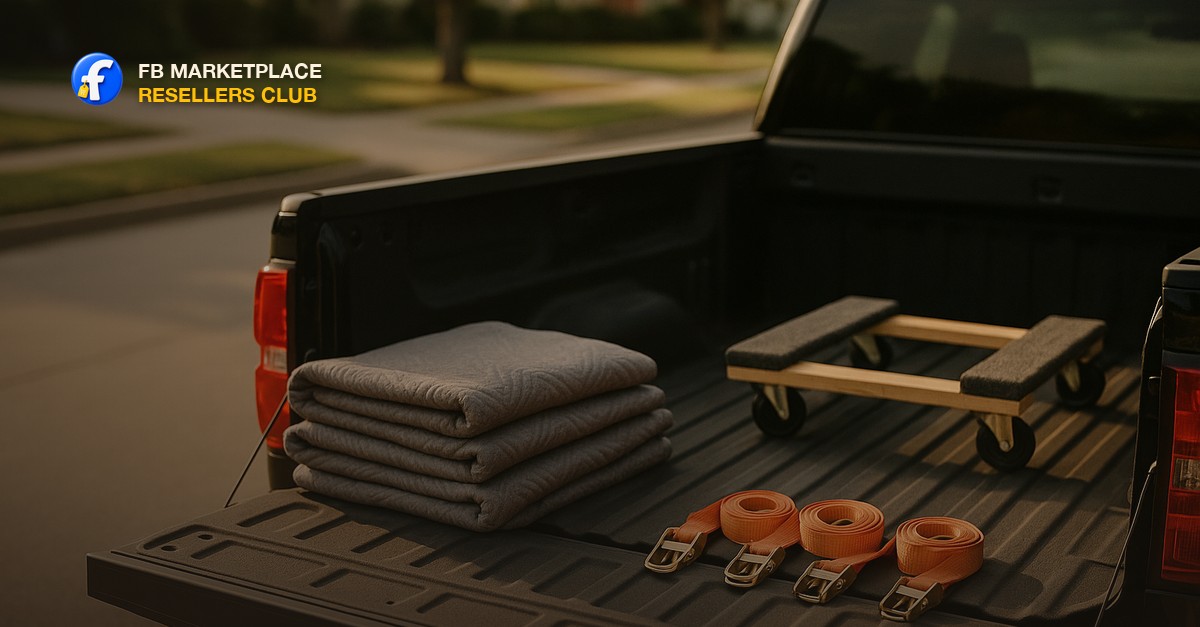
- Keep the kit in the vehicle: moving blankets, ratchet straps, a furniture dolly, a basic tool set, gloves, and a tape measure. Missing one strap turns a delivery into a damage claim.
- Log the actual miles and time on each run for a month. That is how you find out whether your per-mile rate is real or wishful, using your own numbers rather than anyone else's.
Once delivery days are running, they become the backbone of a bigger operation. That is the same lever covered in [how to scale your Facebook Marketplace business](/blog/how-to-scale-your-facebook-marketplace-business), and the buyers who paid for a smooth delivery are the ones most likely to end up on your [repeat buyer list](/blog/how-to-build-a-repeat-buyer-list-on-facebook-marketplace). If bulky items are becoming your main lane, the [furniture flipper guide](/for/furniture-flippers) maps the rest of that workflow.
Short, practical drops on sourcing, pricing with comps, listing copy, and safe meetups. No spam, unsubscribe anytime.
Frequently asked questions
Does Facebook Marketplace offer delivery?
Not for local sales. Marketplace offers shipping through its own checkout with a prepaid label, and it offers local pickup, but it does not build, price, or protect a local delivery service. What it gives you is a door dropoff meetup preference on the listing, which signals to buyers that you are willing to bring the item to them. Everything after that, the fee, the timing, and the payment, is arranged privately in Messenger between you and the buyer.
Should I charge for delivery on Facebook Marketplace?
Yes, and you should quote it before the item price is agreed. Delivery costs you fuel, vehicle wear, and usually an hour or more, none of which was priced into the item. The one exception is building the cost into the item price and advertising delivery included, which works well on bulky furniture because it removes the buyer's biggest objection. What does not work is agreeing a price and then absorbing a delivery request as a closing favor.
How much should I charge for delivery on Facebook Marketplace?
Price it in three parts rather than picking a round number. A flat base fee for loading, strapping, and unloading. A per-mile rate applied to the round trip, since the empty return leg costs the same fuel as the loaded one. Then a handling add-on for stairs, tight access, or a second person. For a defensible per-mile floor, look up the current IRS standard mileage rate for business driving and add your own margin on top of it.
Is it safe to deliver items to a buyer's house?
It is a different risk profile from a public meetup, so it needs its own rules. Deliver in daylight, tell someone where you are going and share your location, keep the handover at the door or driveway where possible, and bring a second person on anything heavy. Collect the money before the item comes off the vehicle. If anything about the address or the buyer's messages feels wrong, set the item down or leave without unloading. No single sale is worth overriding that instinct.
What if the buyer is not home when I arrive with the delivery?
This is exactly why the deposit exists. Take a non-refundable deposit that covers at least the delivery fee before you load, so a no-show costs you time rather than time plus fuel. Confirm the total and the window in the Messenger thread on the morning of the delivery and ask the buyer to confirm it back. If they will not confirm or will not deposit, reschedule instead of driving. Never leave an item unattended at an address to be paid for later.
Does Facebook purchase protection cover a local delivery?
Purchase Protection applies to eligible orders bought with checkout on Marketplace, which means shipped orders paid through the platform. A local delivery paid in cash or by a direct transfer sits outside that, the same as any local pickup sale. Your protection on a delivery is the Messenger thread: the agreed total, the agreed drop point, and what is excluded, written down before you load. Keep the thread rather than moving the conversation to text or a phone call.
Should I offer free delivery to sell an item faster?
Only if the cost is already inside the item price. Free delivery is a strong hook on bulky furniture because moving it is the buyer's real problem, not the price. The mistake is offering it after you have already discounted the item, at which point you are paying twice for the same sale. Decide the delivery-included price before you list, and quote a separate fee for anyone outside your normal radius.
Last reviewed by Nicole on August 22, 2026