
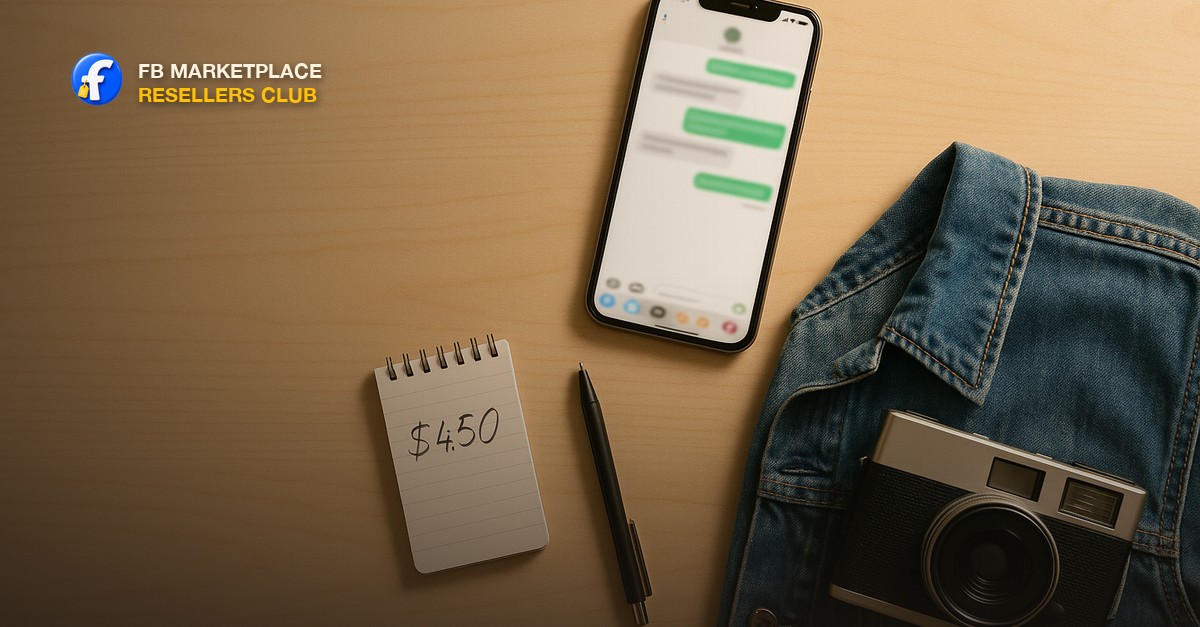
How to make an offer on Facebook Marketplace
To make an offer on Facebook Marketplace that actually gets a reply, send a short message with your number in the first line and a pickup plan attached. Something like: 'Hi, would you take $65? I can pick up this weekend.' That is it. One specific price, one time frame, nothing else needed in the opener. Sellers see hundreds of vague 'what is your best price?' messages and ignore most of them. A clean offer with a concrete number and a ready pickup reads as a serious buyer, and that matters almost as much as the dollar amount.
This post is written for resellers who are on the buy side - making offers to source inventory - not for sellers fielding lowballs. If you flip on Facebook Marketplace, your ability to buy at a good price is the margin. And the margin lives in how you send that first message.
Why most offer messages fail
The most common mistakes resellers make when messaging a seller are not about the price. They are about the format. A message that is too long reads like an essay. A message with no number forces the seller to do the work. A lowball opener with no context signals you are wasting their time. And a message that comes in at 2am from a brand-new account with no reviews looks like a scam inquiry.
- Vague openers like 'what is your best price?' or 'is this negotiable?' make the seller quote a number first, which almost always means you pay more than you needed to.
- Lowball offers with no explanation read as disrespect and often end the conversation entirely, even when the seller would have taken something close to your real budget.
- Long messages with backstory - why you want it, what you plan to do with it, budget explanations - slow the deal and make sellers suspicious.
- No pickup plan. A seller who has to ask 'when can you come?' is now doing your planning for you. Ready availability signals commitment.
- Asking about multiple items in one message. Sellers read this as a time-waster shopping around rather than a buyer ready to move on one specific item.
The offer message formula that works
The message format that consistently gets replies and closes deals is: a friendly one-word greeting, your specific offer number, and your pickup availability. That is three elements. The whole message fits in two sentences.
A few variations that work in practice. If the item has been listed for more than a week: 'Hi, still available? Would you take $80? I can pick up Saturday morning.' The 'still available' opener acknowledges it has been sitting and sets up a lower offer naturally. If the seller already said 'firm' in the listing: message at or near asking and negotiate on pickup logistics instead of price. If the listing has no price listed at all: 'Hi, what are you asking for this? I am local and can pick up this week.' That gets the number on the table without over-committing.
What you are not doing in the opener is explaining yourself, haggling on multiple rounds before agreeing to view it, or asking for a hold without offering a deposit. Those moves all slow the deal and give the seller a chance to pick someone else.
How low can you go without killing the deal
The answer depends on the listing, not a percentage rule. Pull the sold comps on eBay and Facebook Marketplace before you send anything. If you know the item sells used for $120 and this one is listed at $100, you have room to offer $75 to $80 with a straight face. If the listing is already at $60 and comps are $80, there is less room and a $35 offer will likely end the conversation.
A useful anchor: most casual sellers on Marketplace have a private floor that is about 70 to 80 percent of their listing price. They listed at a round number they picked by feel, and they expect some negotiation. An offer right around 70 percent of ask with a ready pickup closes more often than you think, especially on items that have been listed for more than a few days. Items listed at a firm price for three or fewer days from a recent account usually mean the seller is still holding out for asking price. Wait or move on.
- Check sold listings first. Your offer number should connect to what similar items actually sell for, not just what this listing asks.
- Older listings have softer floors. A seller who has been watching a listing sit for two weeks is more motivated than one who posted yesterday.
- One counter is normal. If they decline and counter, meet somewhere in the middle or walk. Multiple rounds of haggling rarely get you to a better price than a fair first offer would have.
- Items with defects listed honestly are the best negotiation leverage. A scratch, a missing part, or a broken piece mentioned in the description is a fair reason to offer less, and most sellers will accept it.
How to follow up when you do not get a reply
Many Marketplace sellers do not check messages daily, especially casual listers who are not running a resale operation. A single polite follow-up message after 48 hours is completely normal and often gets a reply that the first message did not. One follow-up. Not two.
The follow-up message: 'Hi, just following up on my offer for [item]. Still interested if available. Let me know.' That is enough. If there is no reply after the follow-up, the seller either sold it, is not serious about selling, or is not active on Marketplace. Move on. Chasing a seller who is not responding is time that could go toward sourcing the next item.
When to walk away from a deal
Not every negotiation is worth finishing. The deals that cost resellers the most are the ones where they talked themselves into paying too much because they were already emotionally committed. Set your max number before you send the opener and treat it as a real ceiling, not a soft target.
- If the seller has not moved after one round of counter and your number would break the margin on the flip, walk. The deal does not work at their floor.
- If the seller demands a non-refundable hold or a money transfer before showing the item, walk. That is a scam pattern.
- If the item has a defect the seller did not disclose and they will not negotiate on price to reflect it, walk. Condition surprises at pickup are not your problem to solve at the agreed price.
- If pickup logistics become complicated - multiple rescheduled meetups, address changes, payment format demands - walk. A seller who creates friction before the sale is creating friction after it too.
The resale business runs on volume and margin, not on individual deals. There will always be another item. The discipline to walk on a deal that does not pencil out is what keeps the numbers working over time. If you need a framework for whether a deal makes sense before you even message, [how to price a flip using comps](/blog/how-to-price-items-facebook-marketplace) is the right starting point.
Building your buyer reputation on Marketplace
Facebook Marketplace sellers can see your profile, your reviews, and how long your account has been active before they reply to you. A reseller with a clean account and a few good buyer reviews gets replies that a brand-new empty profile does not. This matters more in competitive local markets where the seller has multiple interested buyers.
- Complete your profile with a real photo and full name. Sellers trust a face more than an anonymous icon.
- Follow through on every deal you commit to. A no-show gets you a bad review that sticks to every future offer you send.
- Leave honest reviews as a buyer. It starts a review exchange, and sellers with good reviews are more likely to leave one back.
- Buy and sell on the same account rather than running a separate buyer account. The combined review history looks more credible than a profile that only buys.
Your account history is part of the offer. A seller choosing between two offers at the same price will take the one from the buyer who looks more reliable. That is not something you can manufacture in a single message, but it is something you build over time by showing up when you say you will. The sourcing side of the business is covered in more depth in [estate sale sourcing](/blog/estate-sale-sourcing-guide) and [garage sale sourcing for Facebook Marketplace resellers](/blog/garage-sale-sourcing-for-facebook-marketplace-resellers) - both of which involve in-person deals where your communication style still matters before the negotiation starts.
Short, practical drops on sourcing, pricing with comps, listing copy, and safe meetups. No spam, unsubscribe anytime.
Frequently asked questions
How do you make an offer on Facebook Marketplace?
Tap the Make Offer button on the listing if it is enabled, or send a direct message to the seller with your offer. In practice, most Marketplace deals happen through direct message even when the offer button exists, because it lets you attach context and a pickup plan. Send a short message: your specific dollar amount in the first line, your pickup availability in the second. That format closes more deals than a button-click offer with no message.
What is a good offer percentage on Facebook Marketplace?
There is no fixed percentage that works for every listing. Pull eBay and Marketplace sold comps for the same item in similar condition, then offer at a price that gives you a workable margin after any cleanup or transport cost. Most casual sellers have a private floor around 70 to 80 percent of their listing price and expect some negotiation. Items listed for more than a week tend to have softer floors than freshly posted ones.
Is it rude to negotiate on Facebook Marketplace?
No. Negotiation is expected on most Marketplace listings. The way to keep it respectful is to offer a real number rather than a vague 'what is your best price', to make only one or two counter attempts rather than grinding through five rounds, and to follow through immediately when you agree on a price. What reads as rude is a first offer so low it signals you do not take the seller's time seriously, or ghosting after you have agreed to buy.
What should I say when making an offer on Facebook Marketplace?
Keep it short and specific. A message like 'Hi, would you take $65? I can pick up Saturday' covers everything you need in the opener. Your number is clear, your availability is set, and the seller can say yes or counter without needing more information from you. Avoid explaining why you want the item, describing your budget situation, or asking multiple questions in the first message.
How do I follow up after making an offer on Facebook Marketplace?
Wait at least 48 hours before following up. Then send one short message: 'Just following up on my offer - still interested if it is available.' If there is no reply to that, move on. Casual Marketplace sellers check their messages infrequently and a second follow-up rarely produces a different result than the first.
Should I offer below asking price right away?
Yes, if the comps support it. Make your real offer in the first message rather than starting at asking price and negotiating down. Starting at asking price leaves no room to move, and starting with a vague question about negotiability just adds a round to the conversation. A direct, fair opening offer based on sold comps is the most efficient opener and the one sellers take most seriously.
Last reviewed by Nicole on September 11, 2026