
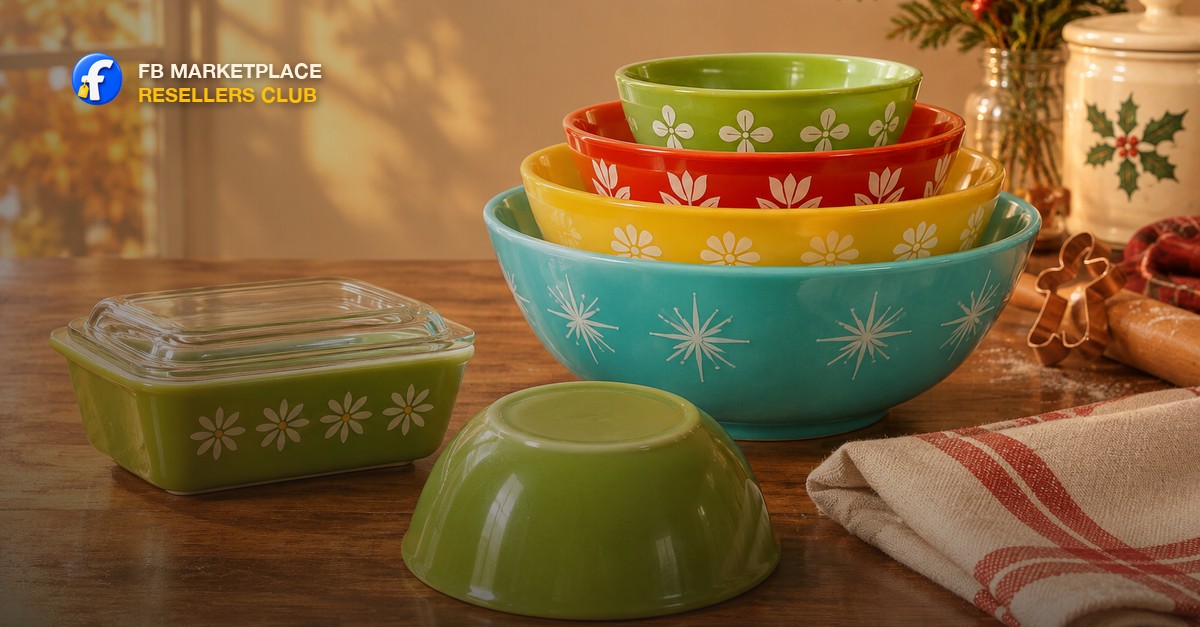
How to flip vintage Pyrex on Facebook Marketplace: the short answer
To flip vintage Pyrex on Facebook Marketplace, buy colored and patterned pieces at estate sales, garage sales, thrift stores and on Marketplace, run the Shine-Chip-Stamp check in person, then hand wash the good ones and list them with daylight photos of the color, the rims and the bottom. Skip anything cracked or chipped, and price dishwasher-dulled pieces as kitchen use, not as collector pieces. Price every piece off what that exact pattern and shape actually sold for near you.
Pyrex sits right next to [cast iron skillets](/blog/how-to-flip-cast-iron-skillets-on-facebook-marketplace) in the kitchen section of an estate sale, and the two flip in a similar way. Both are judged on the item itself, both have a collector market and a cook's market, and both have a few faults that cannot be fixed. The difference is that with Pyrex you cannot clean your way out of most damage. What you see is mostly what you get, so the check before you pay matters even more.
Why vintage Pyrex is worth a look in November
In my view, mid-November is a good time to have clean Pyrex ready to list. Thanksgiving falls on Thursday, November 26, 2026, and Christmas on Friday, December 25, 2026. People are hosting, baking and carrying casseroles to other people's houses, and colorful vintage bowls are an easy gift to understand. Back in the day, some limited Pyrex patterns were sold as holiday gifts in the first place. That is my read of the season, not a measured number, so check how many similar pieces have sold near you before you buy a carload.
The buying side is the other reason. Estate sale kitchens are full of it, because Pyrex was made to be used for decades and a lot of households kept theirs. Many sellers price it all the same, so a common bowl and a sought-after one can sit side by side at the same price. Knowing which is which is the whole edge. The wider seasonal timing is in [how to sell on Facebook Marketplace during the holidays](/blog/how-to-sell-on-facebook-marketplace-during-the-holidays).
Know what you are looking at
Pyrex was first sold to the public in 1915 as clear, heat-resistant glassware. The pieces most buyers mean by 'vintage Pyrex' are the colored and patterned ones made after World War II, especially from the 1950s through the 1970s. The first four printed patterns were Snowflake, Pink Daisy, Butterprint and Gooseberry, and many more followed. Some of the hardest to find were promotional patterns made for a short time, often sold as gifts with a carrier, cradle or candle warmer.
What to read on a Pyrex piece before you price it
| What to check | Where | What it tells you |
|---|---|---|
| Pattern and color | The outside of the piece | The biggest driver of demand. Some patterns were made for years and are common, others had short runs and draw collectors |
| Shape | The whole piece | Mixing bowls are the shape people collect most, and refrigerator dishes and casseroles sell well too. An uncommon shape can matter as much as the pattern |
| Markings | The bottom | The Pyrex name, a shape or size number and sometimes a capacity. Use them to match the piece to sold comps, not to guess its age |
| Lids | Anything that should have one | A refrigerator dish or casserole with its correct lid is worth more than one without. Missing lids are common |
| Set completeness | Nesting bowls and fridge dish sets | Complete sets are harder to find than single pieces, so a full set in one pattern can be worth more than the parts |
Do not trust the logo to tell you how old a piece is or what glass it is made of. The all-lowercase 'pyrex' logo dates back to 1975, and Corning began switching some Pyrex from borosilicate glass to tempered soda-lime glass long before that, so the logo style alone is not a reliable test. Corning spun off its kitchenware business in 1998, and newer pieces are made by other companies. If a piece looks like it could be a less common pattern, compare it against a collector pattern reference before you buy and before you price. The checking habit is the same one in [how to spot fakes before you buy to resell](/blog/how-to-spot-fakes-before-you-buy-to-resell).
The Shine-Chip-Stamp check
The Shine-Chip-Stamp check is how I recommend vetting Pyrex before you pay. Shine and Chip catch the condition problems that decide most of the value. Stamp tells you what you are actually holding, so you can price it.
- Shine. Hold the piece in good light and tilt it. Good vintage Pyrex has glossy, even color. Years in a dishwasher leave the outside dull, chalky or faded, sometimes with a rough feel, and that does not polish back. Then touch it. A sticky or greasy surface can mean someone rubbed oil on a dull piece to make it shine for a sale. Wipe a spot with a paper towel if you are not sure.
- Chip. Run a fingertip slowly around every rim, inside and out, and around the base. Rims take the most knocks, and small chips are easy to miss by eye. Then look through clear pieces and across colored ones in good light for cracks, including hairline ones. Look for utensil marks and scratches in the paint too, since heavy use shows up there first.
- Stamp. Turn it over and read the bottom. Note the Pyrex name, any numbers and anything else printed or molded there, and snap a photo. Then check the lid, if it has one, against the dish so you know whether it is the right lid. Use what you found to search sold comps for that exact pattern and piece before you agree on a price.
Buying from a Marketplace listing instead of in person? Ask for what you cannot check through a screen: a daylight photo with no flash, a close photo of the rims, a photo of the bottom and a straight question about chips, cracks and whether it has been through the dishwasher. A seller who will not answer is telling you something. Negotiate after the check, not before. More in [negotiation and safe meetups](/blog/facebook-marketplace-negotiation-and-safe-meetups).
Where to find vintage Pyrex to flip
- Estate sales: check the kitchen cabinets, the basement and any back shelves, and look for nested bowls still stacked together. See the [estate sale sourcing guide](/blog/estate-sale-sourcing-guide).
- Garage and yard sales: ask whether there are any old dishes or bowls that are not out on the tables. See [garage sale sourcing](/blog/garage-sale-sourcing-for-facebook-marketplace-resellers).
- Thrift stores: check the kitchen and glassware shelves often, because colored pieces get picked up fast. See [thrift store sourcing](/blog/thrift-store-sourcing-for-facebook-marketplace).
- Marketplace itself: set saved searches for 'Pyrex,' 'vintage Pyrex,' 'mixing bowls,' 'refrigerator dish' and 'kitchen lot.' A mixed kitchen box can hide a good piece. See [how to find free items to flip](/blog/how-to-find-free-items-to-flip-on-facebook-marketplace).
- Household auctions: a box of dishes often goes as one lot, which can work if even one piece in the box passes the check.
Learn the patterns you see often in your area before you start shopping, so you can tell a common piece from a less common one at a glance. [How to spot brands worth flipping](/guides/how-to-spot-brands-worth-flipping) covers that habit. For pickups at someone's home, the [safe meetup checklist](/guides/safe-meetup-checklist) still applies.
How to clean and handle Pyrex without hurting its value
With Pyrex, cleaning is about not making things worse. The colored finish is the value, and the dishwasher is the most common way it gets ruined, so every piece you buy gets hand washed only.
- Wash by hand in warm soapy water with a soft sponge. Skip the dishwasher every time, even for a quick rinse.
- Skip abrasive scrubbers and harsh powders on the colored outside. They can scratch or dull the finish you are trying to sell.
- Let the glass come to room temperature before you wash it, and do not put a cold piece into hot water. Sudden temperature changes are what break glass bakeware.
- Dry it fully and store it with a paper towel or soft cloth between nested pieces so the rims do not knock together.
Include basic use notes in your listing, because buyers will cook in what they buy. Glass bakeware should not go on a stovetop, under a broiler or onto a wet or cold surface when hot, and it should go into an oven that is already preheated. Saying this in the listing shows you know the category and heads off a bad experience later.
How to list vintage Pyrex so it sells
Pyrex buyers want to know three things: what pattern and piece is it, what condition is the color in and is anything missing? Answer all three in the listing, because each one you leave open turns into a message, or a buyer who scrolls past.
- Title: Pyrex, the pattern name if you are sure of it, the piece and the condition. For example: 'Vintage Pyrex Butterprint Mixing Bowl Set of 4, Glossy, No Chips.' Only name a pattern you have checked against a reference. More in [listing titles that get clicks](/blog/facebook-marketplace-listing-titles-that-get-clicks).
- Photos: daylight with no flash so the color is true, the full set together, each piece on its own, the rims up close, the bottom and any flaws. See [photo staging basics](/blog/facebook-marketplace-photo-staging-basics).
- Description: pattern, pieces, markings, whether lids are included and correct, how you checked the rims and whether the color is glossy or shows wear. Add the basic glass care notes. The [listing description builder](/tools/listing-description-builder) keeps it tight.
- Bundles: complete sets usually draw more interest than loose pieces, while common single bowls move faster as a mixed kitchen bundle. Compare comps both ways first. See [how to bundle items](/blog/how-to-bundle-items-on-facebook-marketplace).
- Holiday angle: list before Thanksgiving week and again in early December, and mention that a set makes a ready-to-use gift.
Pricing is where people get burned. There are really two markets here too. Common pieces in used condition sell to people who want to bake and serve, and they often go for less than you would expect. Sought-after patterns, complete sets and pieces with glossy color sell to collectors, and those prices reflect rarity and condition. Price each piece off sold comps for that exact pattern and shape in similar condition, then run the numbers through the [flip profit calculator](/tools/flip-profit-calculator). Glass is heavy and fragile, so local pickup is usually simpler than shipping. The tradeoffs are in [local vs shipping flips](/blog/local-vs-shipping-facebook-marketplace-flips).
Common mistakes when flipping vintage Pyrex
- Paying before running a fingertip around every rim.
- Buying a dull, dishwasher-faded piece at collector prices.
- Missing a sticky, oiled surface that is hiding a dull finish.
- Dating a piece, or judging its glass, from the logo alone.
- Putting your inventory in the dishwasher, even once.
- Selling a lid separately from its dish, or listing a set with the wrong lid without saying so.
- Pricing a common bowl like a rare promotional pattern, or the other way around.
- Shooting photos under kitchen lights or flash, so the color looks wrong.
One thing you can do this week
Set saved searches for 'Pyrex' and 'kitchen lot,' then hit one estate sale this weekend and run the Shine-Chip-Stamp check on every colored piece you pick up, even the ones you will not buy, so it becomes automatic. Before you buy, look up sold comps for that pattern and piece near you so you know your ceiling. Then aim to have your first clean set listed before Thanksgiving week.
Short, practical drops on sourcing, pricing with comps, listing copy, and safe meetups. No spam, unsubscribe anytime.
Frequently asked questions
Is flipping vintage Pyrex on Facebook Marketplace worth it?
It can be, when you buy colored or patterned pieces cheap, they pass the Shine-Chip-Stamp check and sold comps near you clear your price. Condition decides most of the value, so a glossy, chip-free piece is a very different buy from a dishwasher-dulled one in the same pattern.
How can I tell if vintage Pyrex has dishwasher damage?
Tilt it in good light. Dishwasher damage shows up as a dull, chalky or faded outside instead of glossy, even color, sometimes with a rough feel. It does not polish back. If the surface feels sticky or greasy, someone may have oiled it to fake the shine.
What vintage Pyrex pieces do buyers look for?
Colored and patterned pieces from roughly the 1950s through the 1970s get the most interest, especially mixing bowl sets and refrigerator dish sets with their lids. Short-run and promotional patterns draw collectors. Check sold comps for the exact pattern and piece rather than assuming a pattern is valuable.
Can I tell how old Pyrex is from the logo?
Not reliably. The lowercase 'pyrex' logo dates back to 1975, and the glass type changed on some pieces over the years, so the logo style alone does not tell you the age or the glass. Use the markings on the bottom to match the piece to a collector pattern reference and to sold comps.
Should I sell chipped vintage Pyrex?
Not as kitchenware. Chipped or cracked glass is not safe to cook in, so I would pass on it as a resale buy. If you already own a damaged piece, be completely upfront that it is for display only.
When is the best time to sell vintage Pyrex on Facebook Marketplace?
In my view, list clean pieces before Thanksgiving on Thursday, November 26, 2026, and again in early December for Christmas gift buyers. People buy kitchenware year-round, so check how similar pieces have sold near you rather than counting on the calendar.
Last reviewed by Nicole on November 11, 2026