
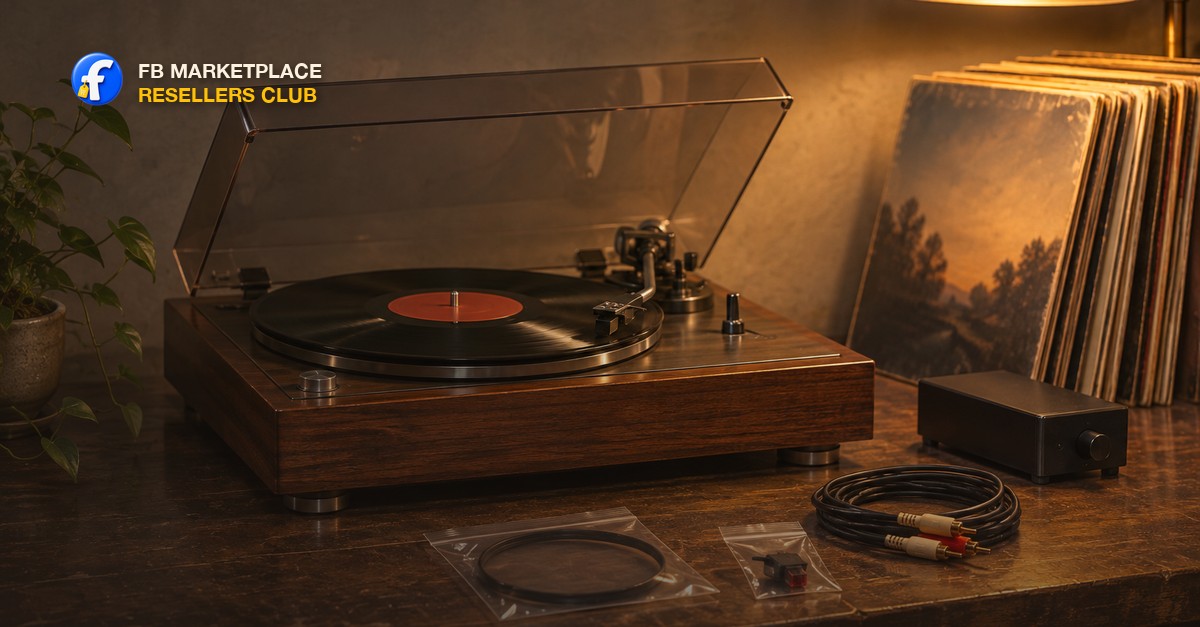
How to flip turntables on Facebook Marketplace: the short answer
To flip turntables on Facebook Marketplace, buy working or easy-to-fix record players cheap from people clearing out a house, run the Spin-Stylus-Signal check before you pay, replace the cheap wear parts like the belt or stylus if needed, then list it with a short video of it playing and the brand, model and drive type in the title. Skip turntables with a dead motor, a bent tonearm or a missing cartridge you cannot identify. Those are repair projects, not flips.
Turntables pair naturally with [vinyl records](/blog/how-to-flip-vinyl-records-on-facebook-marketplace): the same estate sales and basement cleanouts produce both, and the buyer who wants records often needs something to play them on. They flip a lot like other [electronics](/blog/how-to-flip-electronics-on-facebook-marketplace), where proving it works is most of the sale.
What you need to know about how a turntable works
You do not need to be an audio expert to flip turntables, but five parts decide whether one works and what it is worth. Knowing them lets you test a turntable at a pickup and write a listing that answers buyers' questions before they ask.
The parts of a turntable that matter to a flipper
| Part | What it does and what to check |
|---|---|
| Platter and drive | The platter is the round plate the record sits on. A motor turns it either through a rubber belt (belt drive), directly (direct drive) or through a rubber wheel (idler drive). Check that it spins smoothly and holds speed |
| Speed control | Most records play at 33 1/3 rpm (12-inch LPs) or 45 rpm (7-inch singles). Older players often add 78. Check every speed the switch offers |
| Tonearm | The arm that carries the cartridge across the record. It should move freely, sit level and not be bent. Check the lift lever lowers it gently |
| Cartridge and stylus | The cartridge sits at the end of the tonearm and the stylus (the needle) is the tip that touches the record. On many cartridges the stylus pulls off and can be replaced on its own |
| Phono preamp | A turntable's cartridge puts out a very weak signal that needs a phono preamp to boost it. Some turntables have one built in, some receivers have a phono input, and many modern speakers and amps do not. Check which setup this turntable needs |
That last row causes more returns and angry messages than anything else. A buyer who plugs a turntable without a built-in preamp straight into a speaker with no phono input gets a very quiet, thin sound and assumes it is broken. Telling them what it needs up front saves the sale.
The Spin-Stylus-Signal check
The Spin-Stylus-Signal check is how I recommend vetting a turntable before money changes hands. Spin covers the motor and drive, which are the expensive parts. Stylus covers the part that touches the record, which is the most common thing to be missing or worn. Signal confirms it actually makes sound out of both channels.
- Spin. Ask the seller to have it plugged in when you arrive. Turn it on at 33 1/3 and watch the platter. It should start up without help, spin at an even pace and not slow down when you lower the arm onto a record. Switch to 45, and 78 if it has it. Listen for grinding or a hum from the motor. On a belt-drive table, lift the platter mat and look at the belt if you can: a belt that is loose, shiny or cracked is a common cause of slow or wobbly speed.
- Stylus. Look at the end of the tonearm. Confirm there is a cartridge and that the stylus is there and straight, not bent sideways or snapped off. Use your phone's flashlight. Photograph any brand and model printed on the cartridge or stylus guard so you can look up a replacement before you agree on a price.
- Signal. Bring a record you do not care about and a small speaker or headphones that work with the setup. Play a few minutes. You want sound from both left and right, with no crackle that follows the arm rather than the record, and no loud hum. If the seller has the matching receiver, test through it. If you cannot test the sound at all, price it as untested.
Buying from a listing you have not seen in person? Ask for a short video of it playing a record with the sound on, plus a close-up photo of the stylus and the model label on the back or bottom. A seller who cannot send a video is telling you something. More in [negotiation and safe meetups](/blog/facebook-marketplace-negotiation-and-safe-meetups).
What is cheap to fix and what is not
A lot of the margin in turntables comes from buying one with a cheap, common problem and fixing it before you list. The trick is knowing which problems are cheap and which ones eat the profit.
Common turntable problems, sorted by how worried to be
| Problem | How to think about it |
|---|---|
| Stretched or broken drive belt | Usually a cheap fix on a belt-drive table. Replacement belts are sold by model. Look up the model before you buy so you know one exists |
| Worn or missing stylus | Often fixable with a replacement stylus for that cartridge. Identify the cartridge first, because some replacements cost far more than others |
| Dust cover cracked or missing | Cosmetic. It lowers the price but rarely kills the sale. Say so in the listing |
| Dirty, sticky controls | Often a cleaning job. Do not spray anything inside the motor or electronics if you do not know what you are doing |
| Dead motor or no power at all | In my view, a pass unless you know that exact model and can source the part |
| Bent tonearm or broken arm bearing | Hard to fix well. A pass for most flippers |
| One channel dead | Could be a cable, the cartridge wiring or something inside. Price it as a repair, not as working |
Whatever you fix, test again before you list, and keep the old parts until it sells. If a buyer asks what you replaced, you can tell them exactly.
Which turntables are worth flipping
How to think about the common turntable types
| Type | What to watch for |
|---|---|
| Recognized hi-fi brands from the stereo era | Often the best flips in my view, because buyers search for the brand by name. Test everything, since many have sat unused for years |
| Direct-drive DJ-style turntables | Have a dedicated buyer base. Check the pitch control, the platter and that the tonearm is not damaged from heavy use |
| Modern entry-level turntables | Easy to sell to first-time buyers if complete. Many have a built-in preamp and some have Bluetooth or USB, which is worth stating |
| Console stereos and cabinet record players | Big and heavy. The turntable inside can be good or bad, so test it like any other. Delivery matters a lot here |
| Suitcase-style all-in-one players | Popular as gifts but generally the hardest to make money on in my view. Buy very cheap or skip |
| Changers with a tall spindle | Older automatic players that stack records. More moving parts to fail, so test the auto function |
If you do not know a brand, look it up before you pay. The [guide to spotting brands worth flipping](/guides/how-to-spot-brands-worth-flipping) covers how to research a name you have never seen before in a couple of minutes.
Where to find turntables to flip
- Marketplace itself: set saved searches for 'turntable,' 'record player,' 'stereo system,' 'console stereo' and 'receiver.' A stereo system listing often has a turntable that is not in the title. See [how to find free items to flip](/blog/how-to-find-free-items-to-flip-on-facebook-marketplace).
- Estate sales: check the basement, the den and any closet with a stereo cabinet. Record collections and turntables often sit together. See the [estate sale sourcing guide](/blog/estate-sale-sourcing-guide).
- Garage and yard sales: ask whether there is stereo equipment still inside, since sellers often do not bring it out. See [garage sale sourcing](/blog/garage-sale-sourcing-for-facebook-marketplace-resellers).
- Thrift stores: check the electronics shelf often, and ask if there is an outlet you can test at. See [thrift store sourcing](/blog/thrift-store-sourcing-for-facebook-marketplace).
Bring a small test kit to every pickup: a record you do not mind scratching, a small powered speaker or headphones with the right adapter, a phono preamp if you have one, a flashlight and a soft cloth. The [safe meetup checklist](/guides/safe-meetup-checklist) applies when you are going into someone's home.
How to move and store a turntable without damaging it
- Take the stylus off if it pulls off, or put the stylus guard on. A loose stylus is the easiest part to break in a car.
- Lock the tonearm in its rest with the clip or tie it down gently with a twist tie.
- Take the platter off if it lifts off, and lay it flat and wrapped. Belt-drive tables often have the belt on the underside of the platter, so keep it with the platter.
- If the turntable has a transport screw for the platter or suspension, tighten it for the move. Remember to loosen it before you test again.
- Keep the dust cover separate and wrapped, since the hinges crack easily.
- Store it flat in a dry room, away from heat and damp. More in [how to store and organize flip inventory](/blog/how-to-store-and-organize-facebook-marketplace-flip-inventory).
How to list a turntable so it sells
Turntable buyers want to know three things: does it work, what is the model and what do I need to plug it into? Answer all three in the listing, because each one you leave open turns into a message or a buyer who scrolls past.
- Title: brand, model, drive type and the key selling point. For example: 'Belt Drive Turntable, Tested Working, Built-In Preamp, New Belt.' More in [listing titles that get clicks](/blog/facebook-marketplace-listing-titles-that-get-clicks).
- Video: a short clip of a record playing with the sound on is the most convincing thing you can add. Show the platter spinning and the arm on the record.
- Photos: the whole turntable with the dust cover open, the tonearm and cartridge close up, the model label, the back panel with the connections, and any wear. See [photo staging basics](/blog/facebook-marketplace-photo-staging-basics).
- Description: model, drive type, speeds, whether it has a built-in preamp or needs one, what outputs it has, what you tested and how, and anything you replaced. The [listing description builder](/tools/listing-description-builder) keeps it tight.
- Bundles: a turntable sold with a few records, a preamp or a pair of speakers can sell faster to a first-time buyer. Price the bundle off what each part would sell for separately.
Price off sold comps for the same model and condition, then run the numbers through the [flip profit calculator](/tools/flip-profit-calculator) with your parts, gas and time included. Record players are a popular gift, so a tested, complete turntable can be a good listing heading into the holidays. More in [how to sell on Facebook Marketplace during the holidays](/blog/how-to-sell-on-facebook-marketplace-during-the-holidays).
Common mistakes when flipping turntables
- Paying a working price without hearing it play.
- Testing only one speed and finding out later that 45 does not work.
- Not checking for a stylus before driving home.
- Leaving out whether it needs a phono preamp, then getting a "it's broken" message from a buyer.
- Buying a turntable with a cartridge you cannot identify and finding out the replacement stylus costs more than your margin.
- Moving it with the stylus on and the tonearm loose.
- Forgetting to loosen a transport screw and thinking the turntable broke on the way home.
- Overpaying for suitcase-style players because they look cute in photos.
One thing you can do this week
Set saved searches for 'turntable,' 'record player' and 'stereo system,' then open five listings and look for the brand, model and stylus in the photos. Message one seller and ask for a video of it playing, even if you do not buy, so you get used to asking before your first pickup.
Short, practical drops on sourcing, pricing with comps, listing copy, and safe meetups. No spam, unsubscribe anytime.
Frequently asked questions
Is flipping turntables on Facebook Marketplace worth it?
It can be, when you buy cheap from people clearing out a house, the turntable passes the Spin-Stylus-Signal check or needs only a cheap part, and sold comps near you clear your price after parts, gas and time. Proving it works with a video is most of the sale.
How do I test a turntable before buying it?
Ask for it to be plugged in when you arrive. Check that the platter spins at steady speed on every setting, that the stylus is present and straight, and play a record through a speaker or headphones to hear sound from both channels. If you cannot test it, price it as untested.
What does a turntable need to play through speakers?
A turntable's cartridge puts out a very weak signal that needs a phono preamp. Some turntables have one built in, some receivers have a phono input, and others need a separate preamp. State which one applies in the listing.
Should I replace the belt or stylus before selling?
If it fixes a real problem and the part is cheap for that model, usually yes, because a tested, working turntable is easier to sell. Look up the part by model before you buy the turntable so you know it exists and what it costs.
What speeds should a turntable play?
Most records play at 33 1/3 rpm (12-inch LPs) or 45 rpm (7-inch singles). Many older players also have 78. Test every speed the turntable offers and list them in the description.
Are suitcase record players worth flipping?
In my view, they are the hardest to make money on. Buy them very cheap or skip them, and put your time into turntables from recognized brands that buyers search for by name.
Last reviewed by Nicole on November 14, 2026