
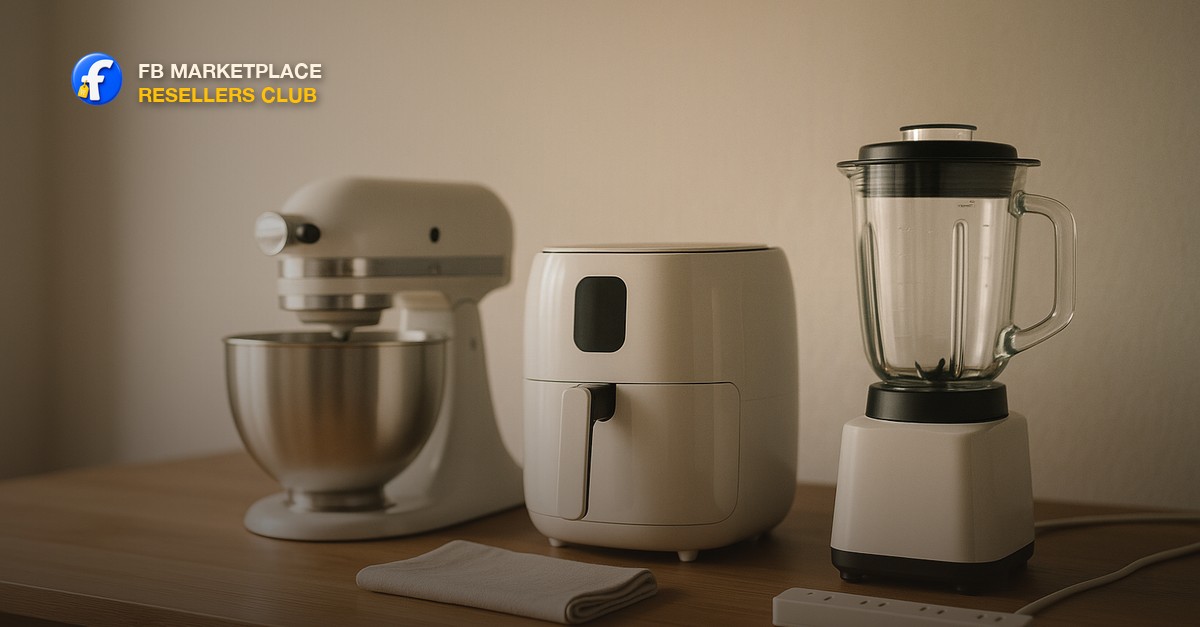
How to flip small kitchen appliances on Facebook Marketplace: the short answer
To flip small kitchen appliances on Facebook Marketplace, buy known brands with a visible model number, test them in person before paying, clean them until they look cared for, and list them with a short video of the unit running. Skip anything with a damaged cord, a cracked housing, or a smell you cannot identify. The category works because the items are small and universally needed. It punishes you only when you skip the test.
Compared with bigger categories, this one is forgiving. A mistake costs you a small amount, not a truck rental and a lost weekend. That makes it a good category for building the habit of testing before buying. The same discipline carries over to [appliances](/blog/how-to-flip-appliances-on-facebook-marketplace) and [electronics](/blog/how-to-flip-electronics-on-facebook-marketplace) once you are ready for bigger tickets.
Which small kitchen appliances are worth flipping
Flip the ones that people search for by name and that have a long working life: stand mixers, blenders, air fryers, espresso machines, pressure cookers and multi-cookers, food processors, and good toasters or toaster ovens. These share three traits. They have recognizable brands, the parts that wear out are easy to inspect, and the buyer knows what they want before they message you.
Small kitchen appliances: what to check and what to avoid
| Item | Check before paying | Walk away if |
|---|---|---|
| Stand mixer | Run every speed; listen for grinding; check the bowl lock and the head tilt | Gears grind or the head will not lock down |
| Blender | Run it with water; check the blade assembly and the seal for play or leaks | Base wobbles, jar is cracked, or the seal leaks |
| Air fryer | Run it empty and confirm it heats; check the basket coating | Coating is flaking or the heater does not get warm |
| Espresso machine | Run a water cycle; check for leaks and for a working steam wand | Leaks, heavy scale, or the pump will not build pressure |
| Pressure cooker or multi-cooker | Check the sealing ring, the lid lock and the pressure valve; confirm it powers on | Lid does not lock, valve is missing, or the ring is brittle |
| Toaster or toaster oven | Confirm every element heats and the timer works | Burnt-in residue, bent racks, or a frayed cord |
The brand matters because it does the selling for you. Buyers search 'KitchenAid stand mixer' and 'Ninja air fryer,' not 'kitchen appliance.' A no-name unit may work perfectly and still sit for weeks, and replacement parts for it will be hard for your buyer to find. If you are unsure which brands hold their value locally, the [guide to spotting brands worth flipping](/guides/how-to-spot-brands-worth-flipping) covers the method.
The Power-Heat-Clean check
The Power-Heat-Clean check is three questions, in order, and you can finish all three in about a minute at the seller's counter. If a unit fails any one, either it is priced as a parts-or-repair item or you walk away.
- Power. Plug it in and run every setting, speed and button. Do not accept 'it worked last week.' Check the cord for cuts, bent prongs and heat damage near the plug. A frayed or scorched cord is a no, whatever the price.
- Heat or load. Make the machine do its actual job. Heating appliances should get hot. Motors should run under a little load, like water in a blender or a full spin on a mixer, without grinding or burning smells. This is the step that catches most failures, because a unit can power on and still be dead underneath.
- Clean. Look at what you would have to fix before a buyer sees it. Stuck-on residue, a cracked lid, a missing jar or a smell of burnt plastic all cost you time or kill the sale. Light grime is fine because you will clean it. Smell and cracks are not.
Safety and recall checks before you resell
Heating appliances and pressure cookers can be dangerous when faulty, so check the model against official recall notices before you buy it to resell. In the US, the Consumer Product Safety Commission publishes recall notices on cpsc.gov, and you can search by brand and product type. It takes a minute and it protects you and your buyer.
- Find the model number, usually on a sticker under the base or on the back, and photograph it before you leave. You need it for the recall search and for the listing title.
- If a unit has been recalled and the fix was not applied, do not resell it. Pass on it, or sell it only if the repair or replacement is genuinely complete and documented.
- Never sell a unit with a damaged cord, exposed wiring, or a lid or valve that does not work correctly. Cheap to skip, expensive to be wrong about.
- Do not make safety claims you cannot back up. Say what you tested and what you saw. Do not say 'safe' or 'like new inside' if you only ran it once.
Selling a faulty item to a neighbor is also a reputation problem. Your seller reputation is built on buyers saying the item matched the listing, and returns or disputes cost you more than a skipped deal ever would. If something does go wrong, [how to handle returns and complaints](/blog/how-to-handle-returns-on-facebook-marketplace) lays out how to respond.
How to clean and prep a small appliance for resale
A clean appliance sells faster and for more because buyers read cleanliness as care. Most prep is about ten to fifteen minutes with supplies you already own, and it is the cheapest margin in the whole category.
- Unplug first, always. Wipe the outside with a damp cloth and a little dish soap, then dry it so no water gets into vents or switches.
- Wash every removable part by hand or as the manufacturer allows: bowls, jars, lids, baskets, trays, drip pans and filters. Replace anything cheap that is missing or worn, like a rubber seal, if a replacement is easy to find and clearly worth it.
- Remove stuck-on residue from heating elements and baskets with a soft cloth or a non-scratch pad. Do not scrape coated surfaces, because scratching the coating can turn a sellable unit into a parts unit.
- Air everything out until it smells neutral. A faint cooking smell is normal. A strong lingering one is a pass.
- Collect all the parts that belong with it. A mixer with its attachments or a blender with both jars is worth noticeably more than the bare base, so photograph what is included.
How to list a small kitchen appliance so it sells
Put the brand, product name and model in the title, show the unit running, and photograph every accessory. Buyers cannot test your item, so your listing has to do it for them. A 10-second video of the machine running does more than three paragraphs of description.
- Title: brand, product, size or model, and condition. For example: 'KitchenAid Artisan Stand Mixer 5qt, Works Great.' Use the words buyers type into search. The pattern is the same one in [listing titles that get clicks](/blog/facebook-marketplace-listing-titles-that-get-clicks).
- Photos: the whole unit on a clean counter, a close-up of the model sticker, the cord and plug, and every attachment laid out together. Good photo basics are in [photo staging basics](/blog/facebook-marketplace-photo-staging-basics).
- Description: what you tested and how, what is included, what is not, and any cosmetic marks. Honesty here saves you a return. Use the [listing description builder](/tools/listing-description-builder) to keep it tidy.
- Pickup terms: say that buyers can plug it in at pickup. Offering a quick demo builds trust and removes the main reason a buyer hesitates.
Small appliances also bundle well. A stand mixer with extra attachments or a blender with a spare jar gives the buyer a reason to pay a bit more and gives you a way to move related items together. The approach is covered in [how to bundle items](/blog/how-to-bundle-items-on-facebook-marketplace).
Common mistakes when flipping small kitchen appliances
- Buying on a seller's word. If you cannot plug it in at pickup, assume it does not work and price it as parts.
- Buying too many of the same item. A shelf of identical air fryers competes against itself. Spread across different items instead.
- Ignoring the cord and the seal. These are the cheapest parts to inspect and the most common cause of a failed unit.
- Overpaying for the brand. A known name earns a premium, not an unlimited one. Check what comparable units actually sold for before you set your ceiling.
- Skipping the demo video. It costs a few seconds and it answers the most common question in your inbox.
- Forgetting storage. Even small items add up. Keep boxes, cords and attachments together, as described in [how to store and organize your inventory](/blog/how-to-store-and-organize-facebook-marketplace-flip-inventory).
One thing you can do this week
Put together a small testing kit this week: a power strip, a water bottle, a flashlight, paper towels and a note on your phone with the three steps (Power, Heat, Clean). Then search your local Marketplace for stand mixers and air fryers, and write down the model numbers and asking prices of five listings. You will have a feel for the local market and a working method ready for the next one you see.
Short, practical drops on sourcing, pricing with comps, listing copy, and safe meetups. No spam, unsubscribe anytime.
Frequently asked questions
Are small kitchen appliances worth flipping on Facebook Marketplace?
They can be, if you buy known brands, test every unit before paying, and clean them well. They are light, easy to store and searched for by name. Margins depend on your local market, so check what comparable units actually sold for near you before setting a buy ceiling.
What kitchen appliances sell best on Facebook Marketplace?
Stand mixers, blenders, air fryers, espresso machines, pressure cookers and multi-cookers, and food processors are strong choices because buyers search for them by brand and model. Local demand varies, so look at how quickly similar listings disappear in your area.
How do I test a used kitchen appliance before buying it?
Plug it in and run every setting. Make it do its real job, like heating up or blending water, and listen for grinding or burning smells. Check the cord, the seals and the lid or lock. Bring a power strip so you can test anywhere. If the seller will not let you plug it in, price it as parts or walk away.
Should I check for recalls before reselling an appliance?
Yes. Photograph the model number and search the brand and product on the Consumer Product Safety Commission's recall page at cpsc.gov. Do not resell a recalled unit unless the repair or replacement is genuinely complete.
How do I clean a used appliance to sell it?
Unplug it, wipe the outside with a damp cloth and mild soap, wash every removable part as the manufacturer allows, and clear residue from baskets and elements without scratching coatings. Air it out until it smells neutral. Smell and cracks are deal-breakers, light grime is not.
What should I put in a listing for a used appliance?
Brand, product, model and condition in the title. In the photos, show the full unit, the model sticker, the cord and every attachment. In the description, say what you tested, what is included, and any cosmetic marks. A short video of it running builds more trust than extra text.
Last reviewed by Nicole on October 2, 2026