
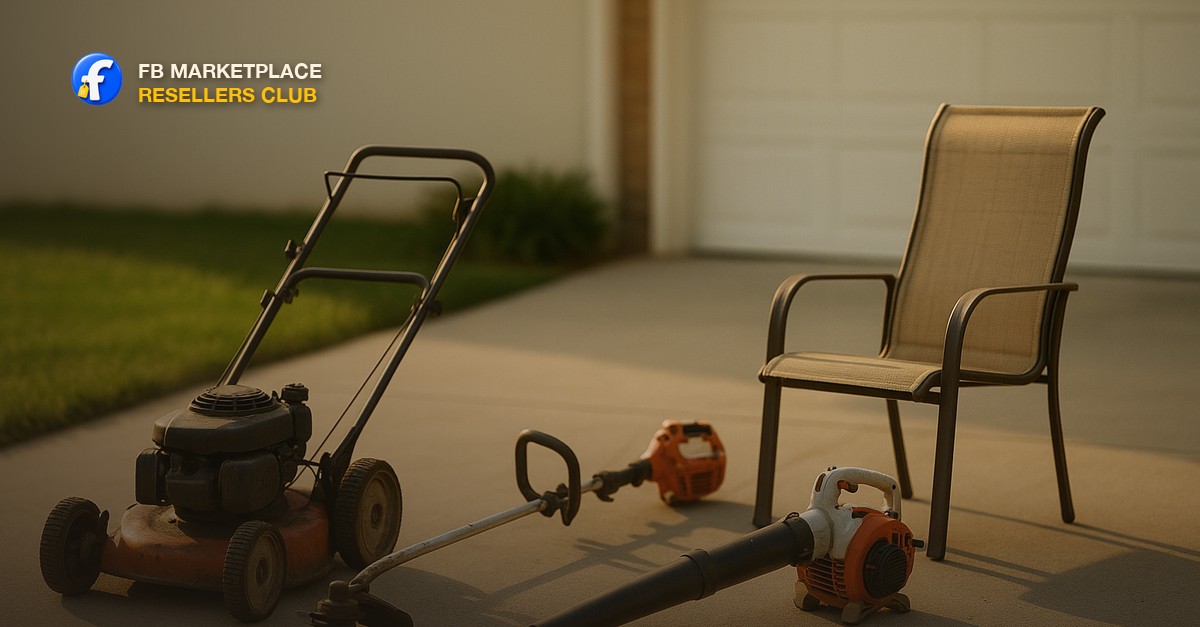
How to flip lawn and garden equipment on Facebook Marketplace, the short answer
The fastest way to flip lawn and garden equipment on Facebook Marketplace is to split every listing into two buckets before you look at the price: gas-powered equipment (push mowers, riding mowers, string trimmers, leaf blowers, tillers, chainsaws) and non-powered gear (patio furniture, wheelbarrows, hand tools, hoses, planters). Gas equipment is where the margin lives, because most sellers cannot test it confidently and price it off a rough guess. Non-powered gear is lower-risk and easier to move but carries a thinner margin. Then let the calendar do half the work: buy in the off-season when sellers want it gone, and list into the front edge of the season when buyers are hunting. That one habit is the difference between a slow flip and a fast one in this category.
Why lawn and garden equipment is a strong category to flip
Three ordinary, repeatable things keep this category stocked with underpriced listings. First, this stuff is bulky and heavy, so anyone moving, downsizing, or clearing out a parent's garage wants it gone that weekend and prices it to disappear rather than to get top dollar. Second, most sellers genuinely do not know what they own. They know a mower cost a certain amount new and they knock a rough discount off that number, which has almost nothing to do with what a clean, running mower is actually worth used. Third, and this is the big one, the demand is wildly seasonal, so the same mower that nobody wants in November has three eager buyers in April.
That seasonality is the edge, not the obstacle. A running push mower listed in late fall might sit for weeks and eventually sell cheap because nobody is thinking about their lawn. The exact same machine, cleaned up and listed the first warm week of spring, sells in a day at a real price. You are not just buying an item in this category. You are buying it at the wrong time of year on purpose, storing it for a few weeks or months, and selling it at the right time. That timing gap is a big part of where the money is.
The Prime-Pull-Run Check: testing gas equipment in five minutes
You do not need to be a small-engine mechanic to buy gas equipment safely. You need a short checklist you run in the same order every time, standing in someone's driveway, before any money changes hands. Never buy a piece of gas equipment that the seller cannot or will not start in front of you. A machine that will not run is not a flip, it is a repair project, and repair projects are a different business than flipping.
The Prime-Pull-Run Check
| Step | What you are doing | What it tells you |
|---|---|---|
| Prime and fuel | Confirm there's fresh fuel in it, or bring a little of your own; check the oil is not black or empty | Old fuel gums up carburetors. Fresh fuel plus a start rules out the single most common no-start cause |
| Pull to start | Start it yourself, or watch the seller do it, on the first or second pull cold | A machine that fires up easily has a healthy carburetor and spark. Endless pulling is a warning sign |
| Run for a full minute | Let it idle and rev; listen for a steady engine, watch for smoke | Blue or white smoke, stalling, or a rough surge points to real engine trouble, not a quick fix |
| Check the cutting deck or head | On mowers, look under the deck for rust-through and check the blade; on trimmers, check the head and shaft | A rusted-through deck or a bent shaft is a walk-away. A dull blade or worn line is a cheap, expected fix |
| Wheels, belts, cords | Spin wheels, check self-propel belts, and inspect any electric cords for cuts | Cheap, predictable fixes. Factor a small repair cost into your offer rather than walking |
What actually sells: the equipment worth chasing
Not every piece of yard gear is worth your time or your truck space. The best flips are the ones with strong seasonal demand, a recognizable brand a buyer trusts, and a size that one or two people can move without a trailer. A clean, running self-propelled mower from a brand people know moves fast every spring. So do string trimmers, leaf blowers, and pressure washers that start on the first pull. Patio furniture sets in good shape are a reliable spring and early-summer flip because a full matching set is annoying for the average person to assemble from scratch.
- Self-propelled and push mowers from brands with parts still sold at any hardware store sell fastest, because a buyer knows they can fix it later
- String trimmers, leaf blowers, and pressure washers are lighter, easier to move, and start-test in seconds, which makes them low-friction flips
- Patio and outdoor furniture sets in matching, undamaged condition carry a strong spring premium and move well as a bundle
- Riding mowers and lawn tractors are the biggest ticket in the category, but they need a trailer and a helper, so only chase them once you can move them
- Snow blowers flip the same way in reverse: source them cheap in spring when nobody wants them, sell them at the first cold snap
Timing the season: buy in the off-season, sell into demand
This is the one category where the calendar matters as much as the condition. Demand for lawn and garden equipment climbs hard the first warm week of spring, holds through early summer, and falls off a cliff by late fall. Snow blowers run the opposite cycle. If you buy with that curve in mind, you can pick up a running mower cheap in October, sit on it through winter in a corner of the garage, and list it the first week the grass starts growing, when three buyers are competing for it instead of none.
Seasonal buy-and-sell windows for common gear
| Item | Best time to source (cheap) | Best time to sell (high) |
|---|---|---|
| Push and self-propelled mowers | Late fall and winter | First warm weeks of spring |
| String trimmers and leaf blowers | Winter and early spring | Spring through early summer |
| Patio and outdoor furniture | Fall and winter | Spring and early summer |
| Riding mowers and lawn tractors | Late fall through winter | Early to mid spring |
| Snow blowers | Spring and summer | First cold snap and first snowfall |
The practical move is to keep buying through the off-season while everyone else has stopped thinking about yard work, then hold a small stock of cleaned-up, tested machines ready to list the moment the weather turns. You are effectively front-running the season. For the fuller logic on when to post so listings land in front of active buyers, see [the best time to post for fast sales](/blog/best-time-to-post-on-facebook-marketplace).
Pricing lawn and garden equipment: comps first, buy ceiling second
Price gas equipment and non-powered gear on two different curves. A running gas machine from a known brand sells for a real fraction of new when it's clean and starts easily, because the buyer is paying for the confidence that it works. A non-runner or an off-brand piece with no parts support is worth far less no matter how it looks in the photo. Non-powered gear like patio sets and hand tools is steadier but thinner, so your margin comes from volume and from bundling, not from any single big score.
Whichever bucket you're in, check real sold comps in your own area before you set a number. The full method is in [how to price a flip using comps](/blog/how-to-price-items-facebook-marketplace). Set your [buy ceiling](/glossary/buy-ceiling) at roughly 40 to 50 percent of what the item actually sold for recently near you, not what feels like a deal standing in someone's driveway. On any gas piece, subtract your estimate of a tune-up, a new blade, or a fresh pull cord from that ceiling before you make an offer, so a small repair never eats your whole margin.
Moving and logistics: this is a local-pickup category
Lawn and garden equipment is heavy, awkward, and often full of fuel and oil, so this is a local-pickup category by default. Mowers with gas in them cannot be shipped safely or legally through normal carriers, and a riding mower or a patio set is a non-starter for shipping on weight alone. The small exceptions are light, drainable, fuel-free items like a pole saw attachment or a set of hand tools. For the full breakdown of when shipping is worth it versus when it never makes sense, see [local vs shipping for your flips](/blog/local-vs-shipping-facebook-marketplace-flips).
- Drain or run down the fuel before transport, and keep the machine upright so oil doesn't foul the engine or leak in your vehicle
- Bring straps, a hand dolly, and a helper for anything over about 60 pounds; riding mowers need a trailer and a second set of hands
- Ask about ramps, gates, and how the seller currently gets the equipment in and out before you agree to buy it, not after you arrive with a truck
Safety, disclosure, and what to walk away from
Disclose every defect you find, every time. This is powered equipment with blades, hot engines, and fuel, so the honesty bar is higher than it is on a coffee table. If a mower blade is bent, if a trimmer guard is missing, if a deck is rusting through, say so in the listing and price it accordingly. Never resell a machine with a compromised safety feature quietly working as if it's fine, and never hand a buyer a piece of equipment that stalls unpredictably or leaks fuel.
A simple weekly routine for sourcing yard-gear flips
Treat this category like a route, not a one-off hunt, and lean into the off-season when competition from other buyers is thin. Set saved searches for the terms sellers actually type (mower, lawn mower, trimmer, leaf blower, patio set, snow blower) and check them daily instead of scrolling the whole feed. When something worth seeing turns up, run the Prime-Pull-Run Check in person, confirm your buy ceiling against real comps first, and hold it until the season turns in your favor.
- Save searches for your target terms and check them daily, especially in the off-season when prices are lowest
- Pull sold comps and set your buy ceiling before you leave the house to look at a machine
- Run the Prime-Pull-Run Check in person and never pay for a gas piece that won't start in front of you
- Clean it, do the cheap fix, and hold it until the front edge of the season before you list
Short, practical drops on sourcing, pricing with comps, listing copy, and safe meetups. No spam, unsubscribe anytime.
Frequently asked questions
What lawn equipment sells best on Facebook Marketplace?
Clean, running self-propelled and push mowers from recognizable brands sell fastest and most reliably, especially in spring. String trimmers, leaf blowers, and pressure washers move quickly too because they're lighter and easy for a buyer to transport. Matching patio furniture sets in good condition are a strong spring flip since a full set is a hassle for most people to assemble from scratch.
How do I test a used lawn mower before buying to resell?
Run the Prime-Pull-Run Check: confirm fresh fuel and non-black oil, start it on the first or second pull, and let it run for a full minute watching for smoke or stalling. Then look under the deck for rust-through and check the blade. Never buy a gas machine the seller cannot start in front of you, because a non-runner is a repair project, not a flip.
When is the best time to sell lawn and garden equipment?
The first warm weeks of spring bring the hungriest buyers for mowers, trimmers, and patio furniture, and demand holds through early summer. Source in the off-season, fall and winter, when sellers want the equipment gone and prices are lowest, then hold it and list into the front edge of the season. Snow blowers run the opposite cycle: buy them cheap in spring, sell them at the first cold snap.
Can you ship lawn mowers on Facebook Marketplace?
No, not safely or legally through normal carriers. Gas mowers contain fuel and oil, and riding mowers and patio sets are far too heavy and bulky to ship affordably. Lawn and garden equipment is a local-pickup category by default. The only real exceptions are light, fuel-free items like hand tools or attachments.
How much can you make flipping lawn and garden equipment?
It varies by item and season, and it depends entirely on real sold comps in your area, so there's no single number that's honest to promise. The margin comes from two places: buying gas equipment cheap because sellers can't test it and price it off a guess, and buying in the off-season to sell into spring demand. Set your buy ceiling at 40 to 50 percent of recent local sold prices and let the seasonal timing do the rest.
Last reviewed by Nicole on September 15, 2026