
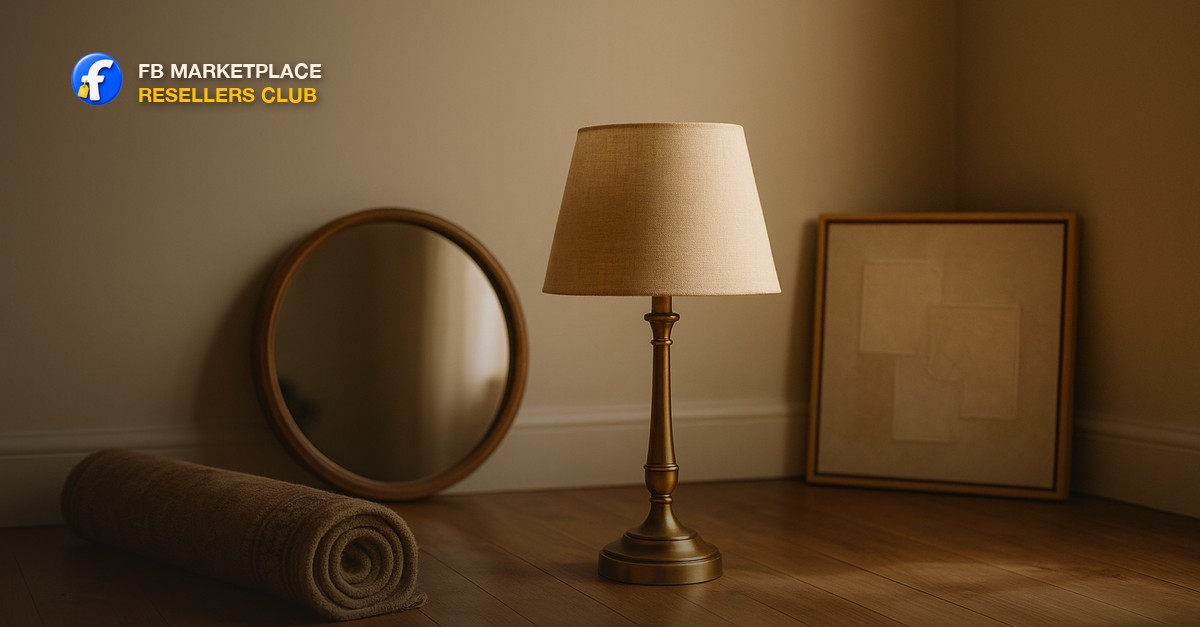
How to flip home decor on Facebook Marketplace: the short answer
To flip home decor on Facebook Marketplace, buy lamps, mirrors, rugs and wall art that have a clear style or quality material, check each one for the flaw that would kill the resale, clean it, and list it styled in a room with measurements in the description. Skip anything with damaged wiring, cracked glass or a smell you cannot remove. Decor is a looks-first category: buyers decide from the first photo, so your margin comes from spotting good pieces that were photographed badly and presenting them well.
Decor sits in a sweet spot between small items and big furniture. Most pieces fit in a car, there is no assembly, and you can store a lot of it in a small space. It pairs naturally with [furniture flipping](/blog/how-to-flip-furniture-on-facebook-marketplace): the lamp and mirror you pick up on the same run are often what make your furniture photos look finished.
Which home decor is worth flipping
Flip the decor that has a reason to exist beyond being cheap. That means one of three things: a recognizable style buyers search for (mid-century, brass, rattan, farmhouse, vintage), a quality material (solid wood frames, solid brass, wool or hand-knotted rugs, real canvas), or a size that is hard to find new without paying a lot (large floor mirrors, big area rugs, oversized wall art). Generic mass-market decor with none of those traits sits, because the buyer can get the same thing new with free returns.
Home decor: what to look for and what to skip
| Item | Worth flipping when | Skip when |
|---|---|---|
| Table and floor lamps | Solid base (brass, ceramic, wood), a distinct style, and a working switch and cord | Cord is cracked, frayed or brittle, or the lamp only works when you wiggle it |
| Mirrors | Large size, solid frame, clean silvering with no dark spots | Cracked glass, spreading dark edge spots, or a frame coming apart |
| Area rugs | Wool or hand-knotted construction, a sought-after style, and a size people actually need | Strong odor, pet stains, moth damage, or a rubbery back that is crumbling |
| Wall art and framed prints | Real canvas or a quality frame, a style that fits current rooms, or an original piece | Water damage, warped frame, faded or yellowed print, or a damaged mat |
| Vases, planters and accents | Heavy ceramic, glass or stoneware with a maker mark or a distinct look | Chips on the rim, hairline cracks, or generic store stock |
Lean toward pieces you can bundle. A matching pair of lamps is worth more than two single lamps, and a lamp, a mirror and a piece of art in the same style can be sold as a ready-made room look. The method is in [how to bundle items](/blog/how-to-bundle-items-on-facebook-marketplace). If you are not sure which styles move in your area, the [guide to spotting brands worth flipping](/guides/how-to-spot-brands-worth-flipping) covers how to read local demand.
The Wire-Glass-Fiber check
The Wire-Glass-Fiber check is how I avoid the three flaws that kill decor resales. Each one matches a type of item, and each takes about a minute in person. If a piece fails, it is either priced as a project or you walk away.
- Wire (lamps and light fixtures). Bring a bulb you know works and ask to plug the lamp in. Turn it on and off several times and run every setting on a three-way switch. Then run your fingers along the whole cord, looking for cracks, stiff or brittle sections, tape repairs and a loose plug. A lamp that flickers when you move the cord has a wiring fault, not a bulb problem.
- Glass (mirrors and framed art). Look at the glass at an angle in good light for cracks and chips, especially at the corners. On mirrors, check the edges for dark or cloudy spots where the reflective backing is failing, often called desilvering. Small spots at the very edge can sometimes be hidden by a frame. Spots spreading into the middle cannot be fixed cheaply.
- Fiber (rugs and textiles). Smell it up close, flip a corner, and look at the back. Strong odors, especially pet urine, rarely clean out fully. A small UV flashlight makes many pet stains glow, so it is worth carrying one. Check the back and fringe for moth damage, bare patches and a crumbling rubber backing.
Quick material checks that protect your margin
In decor, the material is often where the value hides, and sellers do not always know what they have. A few quick checks tell you whether a piece is the real thing or a lookalike.
- Brass: hold a magnet to it. Solid brass is not magnetic. If the magnet sticks, the piece is plated steel or iron underneath. Plated pieces can still sell, but they should not be priced or described as solid brass.
- Rugs: look at the back. On a hand-knotted rug, the pattern shows clearly through the back and the knots are slightly irregular. On a machine-made rug, the back is very even, and the fringe is often sewn on as a separate strip rather than being the ends of the rug itself.
- Wood frames: check the corners and the back. Solid wood shows real grain at the cut ends. Thin veneer or foam frames are lighter and often show a printed grain pattern that repeats.
- Wall art: look closely at the surface. A print usually shows a regular dot pattern up close or under a magnifier, while a painting shows brush texture and raised paint. Do not call anything an original unless you are confident. When in doubt, describe what you see.
These checks are about honest description as much as buying. A listing that says 'solid brass' on a plated lamp turns into a return, and returns cost you more than any single sale is worth. If something does come back, [how to handle returns and complaints](/blog/how-to-handle-returns-on-facebook-marketplace) lays out how to respond.
Where to find home decor to flip
Decor shows up wherever people are clearing out a home, which means it is in almost every sourcing channel you already use. The best deals come from sellers who are moving, downsizing or redecorating and want the space back more than they want the money.
- Estate sales: whole households of decor priced to clear, often with better quality pieces than you will find anywhere else. The approach is in the [estate sale sourcing walkthrough](/blog/estate-sale-sourcing-guide).
- Thrift stores: lamps, frames and mirrors turn over constantly, and they are often priced without regard to material. See [thrift store sourcing for Facebook Marketplace](/blog/thrift-store-sourcing-for-facebook-marketplace).
- Garage sales: decor is one of the most common items on the table, and end-of-day prices drop fast. [Garage sale sourcing](/blog/garage-sale-sourcing-for-facebook-marketplace-resellers) covers timing.
- Marketplace itself: search for 'moving sale,' 'must go,' and specific terms like 'brass lamp,' 'floor mirror' or 'wool rug.' Badly photographed listings are the opportunity here.
- Free listings: decor is often given away during moves. [How to find free items to flip](/blog/how-to-find-free-items-to-flip-on-facebook-marketplace) shows where to look.
How to clean and prep decor for resale
Decor sells on looks, so prep matters more here than in almost any other category. Most of it is simple cleaning that takes minutes, not restoration.
- Lamps: unplug, dust the base and shade, and wipe the base with a damp cloth. A stained or torn shade can make a good base look cheap. Replacing a worn shade with a plain new one is often worth it for a lamp with a quality base. Leave any rewiring to someone qualified, and never sell a lamp with a damaged cord.
- Mirrors and glass: clean both sides of the frame, then the glass with a streak-free cleaner applied to the cloth, not sprayed on the glass, so liquid does not run behind it into the backing.
- Rugs: vacuum both sides, then shake or beat out the dust. Spot-clean as the fiber allows. If it needs more than that to pass the smell test, it was not a good buy.
- Wall art: dust the frame, clean the glass, and check that the hanging wire or hook is secure. A loose wire is a two-minute fix that buyers notice.
How to list home decor so it sells
Sell the room, not the object. A lamp on a garage floor looks like clutter. The same lamp on a side table next to a chair looks like something a buyer wants in their living room. Decor buyers are shopping with their eyes, so the photo carries most of the sale.
- Title: style, material, item and size. For example: 'Vintage Solid Brass Table Lamp, 28 in Tall, Works.' Use the words buyers search, as in [listing titles that get clicks](/blog/facebook-marketplace-listing-titles-that-get-clicks).
- Photos: first photo styled in a simple room setting, then a plain shot, then close-ups of the material, any maker mark and any flaws. For lamps, show it lit. For mirrors, shoot at an angle so you are not in the reflection. More on this in [photo staging basics](/blog/facebook-marketplace-photo-staging-basics) and the [guide to photos that sell](/guides/how-to-take-photos-that-sell).
- Measurements: always include height, width and, for rugs, both dimensions. Size is the most common question for decor, and leaving it out costs you buyers who will not bother to ask.
- Description: what you checked and how, the material, and any marks. Use the [listing description builder](/tools/listing-description-builder) to keep it tight.
Timing helps too. Decor and hosting pieces tend to get more attention as people prepare their homes for the holidays, which is covered in the [holiday Q4 playbook](/blog/how-to-sell-on-facebook-marketplace-during-the-holidays). Fragile pieces are also a good reason to stay local: mirrors and framed glass break easily in shipping, so read [local vs shipping for your flips](/blog/local-vs-shipping-facebook-marketplace-flips) before you offer it.
Common mistakes when flipping home decor
- Buying on taste instead of demand. Your own style is not the market. Check how quickly similar pieces disappear in your area before you buy more than one of anything.
- Skipping the plug-in. A lamp that is 'probably just the bulb' is often the cord or switch. Bring your own bulb and test it.
- Ignoring smell. A rug or textile that smells will smell in the buyer's car and in their home. No price makes that a good flip.
- Overstating material. Plated is not solid, a print is not an original, and machine-made is not hand-knotted. Describe what you can verify.
- Leaving out measurements. It is the first question buyers ask about decor, and many will scroll past rather than message to find out.
- Letting small pieces pile up. Decor is easy to buy and easy to lose track of. Give each piece a numbered spot, as in [how to store and organize your inventory](/blog/how-to-store-and-organize-facebook-marketplace-flip-inventory).
One thing you can do this week
Build the decor kit this week: a working bulb, a UV flashlight, a tape measure and a magnet. Then search your local Marketplace for 'brass lamp,' 'floor mirror' and 'wool rug,' and note the asking price, photo quality and how long five listings stay up. You will learn which styles move near you and spot the badly photographed listings that are your real opportunity.
Short, practical drops on sourcing, pricing with comps, listing copy, and safe meetups. No spam, unsubscribe anytime.
Frequently asked questions
Is home decor worth flipping on Facebook Marketplace?
It can be, if you buy pieces with a clear style, a quality material or a hard-to-find size, check them for hidden flaws, and present them well. Decor is easy to transport and store. Margins depend on your local market, so check what similar pieces actually sold for near you before setting a buy ceiling.
What home decor sells best on Facebook Marketplace?
Lamps with solid bases, large mirrors, wool or hand-knotted rugs, quality framed art, and matching pairs or sets tend to do well because buyers search for them by style and material. Local demand varies, so watch how quickly similar listings disappear in your area.
How do I check a used lamp before buying it?
Bring a bulb you know works, plug the lamp in, and switch it on and off several times through every setting. Run your fingers along the whole cord for cracks, brittle sections and tape repairs. If it flickers when the cord moves, it has a wiring fault. Do not resell a lamp with a damaged cord.
How can I tell if brass is solid or plated?
Hold a magnet to it. Solid brass is not magnetic, so if the magnet sticks the piece is plated over steel or iron. Plated pieces can still sell, but describe them honestly rather than as solid brass.
How do I tell if a rug is hand-knotted?
Flip it over. On a hand-knotted rug the pattern shows clearly through the back and the knots are slightly irregular, and the fringe is the ends of the rug itself. Machine-made rugs have a very even back and often have the fringe sewn on as a separate strip.
Should I ship mirrors and framed art?
Usually not. Glass breaks easily in transit, and a broken mirror means a refund and a lost item. Large mirrors and framed glass are best sold for local pickup. Small, sturdy decor like ceramic vases can ship if you pack them well.
Last reviewed by Nicole on October 4, 2026