
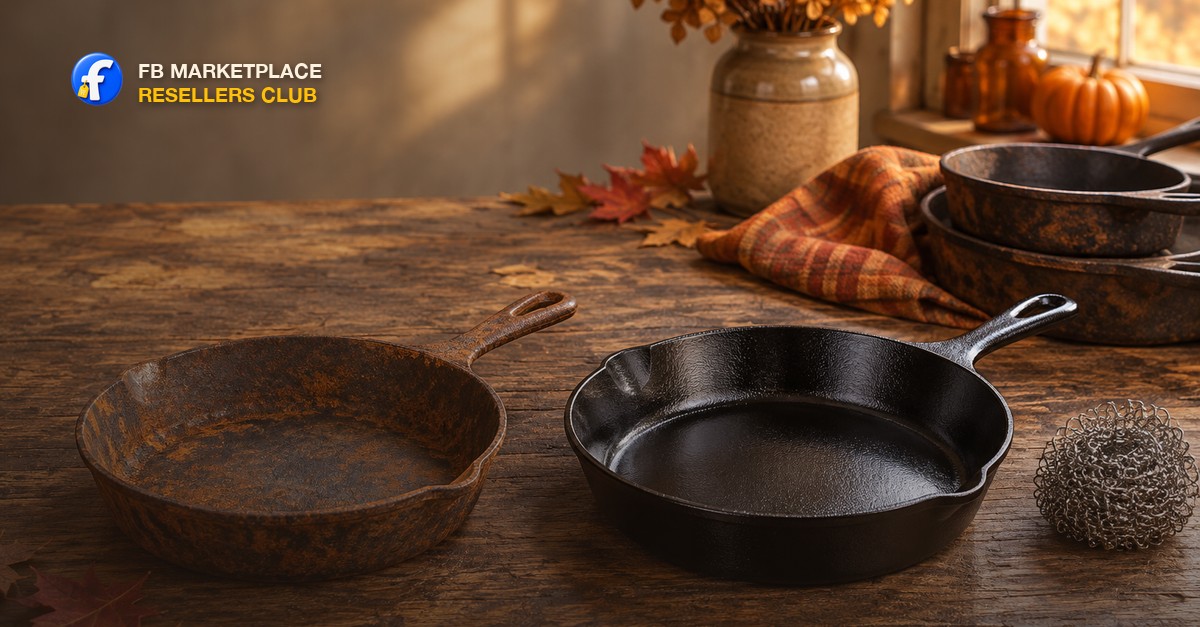
How to flip cast iron skillets on Facebook Marketplace: the short answer
To flip cast iron skillets on Facebook Marketplace, buy dirty or rusty pans cheap at estate sales, garage sales, thrift stores and on Marketplace itself, run the Ring-Rock-Pit check in person, then clean and re-season the good ones and list them with clear photos of the cooking surface and the markings on the bottom. Skip anything cracked, warped or deeply pitted, because none of those can be fixed. Price every pan off what similar pans actually sold for near you, not off what the internet says a famous brand is worth.
Cast iron fits nicely next to the other kitchen categories we cover, like [small kitchen appliances](/blog/how-to-flip-small-kitchen-appliances-on-facebook-marketplace). The difference is that a skillet has no motor to fail and no cord to test. What you are judging is the metal itself, and the checks below take a couple of minutes once you know them.
Why cast iron is worth a look in November
In my view, mid-November is a good time to have cleaned, seasoned pans ready to list. Thanksgiving falls on Thursday, November 26, 2026, and Christmas on Friday, December 25, 2026, so people are cooking more and shopping for gifts at the same time. A restored skillet is an easy gift to understand. That is my read of the season, not a measured number, so check how many similar pans have sold near you before you buy a stack of them.
The buying side matters more than the season. Old cast iron often comes out of a basement, a barn or a relative's kitchen covered in rust or decades of black crust, and a lot of people assume it is ruined. Surface rust and buildup are not damage. They come off, and the pan underneath is usually fine. That gap between how a pan looks and what it actually is, is where the flip lives. The wider seasonal timing is in [how to sell on Facebook Marketplace during the holidays](/blog/how-to-sell-on-facebook-marketplace-during-the-holidays).
Know what you are looking at: vintage versus modern pans
Older American cast iron is often smoother and lighter than a new pan of the same size. Foundries used to grind and polish the cooking surface as a finishing step, and most stopped doing that around the middle of the twentieth century. A new mass-market pan is left with the pebbly, sand-cast texture. That smooth surface is a big part of why buyers look for old pans, though it is a finish, not better metal.
What to read on a cast iron pan before you price it
| What to check | Where | What it tells you |
|---|---|---|
| Maker's mark or logo | Bottom of the pan | Names like Griswold and Wagner draw collector interest, and logo styles changed over the decades, which is how collectors date a pan |
| Size and pattern numbers | Bottom, sometimes the handle | Helps you match the pan to sold comps, and some sizes and patterns are less common than others |
| Cooking surface texture | Inside the pan | Smooth and polished usually points to older manufacture, while a pebbly texture usually points to a newer pan |
| Heat ring | Raised rim around the outside of the bottom | A design made to sit in an old wood-burning stove top. It points to an older design but can scratch a glass cooktop, so mention it in the listing |
| Weight | Pick it up | Older pans are often noticeably lighter than a modern pan of the same diameter |
Do not try to date a pan from memory or from a seller's guess. Collector groups publish detailed logo and pattern references, and if a pan looks like it could be a named collector piece, compare it against one before you buy and before you price. Markings can be hard to read under rust or crust, so a clean pan sometimes turns out to be more, or less, than it looked. [How to spot fakes before you buy to resell](/blog/how-to-spot-fakes-before-you-buy-to-resell) covers the habit of checking before you trust a label.
The Ring-Rock-Pit check
The Ring-Rock-Pit check is how I recommend vetting a pan before you pay. Each step catches one of the three faults that cannot be fixed. Everything else on an old pan, including rust, black crust and patchy seasoning, is a cleaning job.
- Ring. Look over the pan in good light, paying close attention to where the handle meets the body and across the bottom. Then hold it by the handle and tap the rim with a knuckle or a metal spoon. A sound pan gives a clear, sustained ring, while a cracked one tends to give a dull thud. It is not foolproof, because heavy buildup can muffle the sound and hide a hairline crack, so look extra hard at a crusty pan. One more trick: a scratch running up the inside wall that has a matching line on the outside and crosses the rim is a crack, not a scratch.
- Rock. Set the pan on a flat, hard surface and press down around the rim. A flat pan stays still. A warped one rocks, sometimes with a little click, and a badly warped one will spin. A pan can also bow upward in the middle and still sit flat on its edge, so lay a straightedge across the cooking surface too. Bring a small level or a ruler to sales for this.
- Pit. Run a fingertip over the cooking surface. Smooth but dark is fine. Rough craters, where rust has eaten into the metal, are deep pitting, and that does not clean out or season evenly. Check around the bottom edge and inside the heat ring, where water tends to sit. Small pockmarks on the outside bottom of very old pans are a different, mostly cosmetic kind of wear from old coal and gas stoves, but they still matter to collectors.
Buying from a Marketplace listing instead of in person? Ask for what you cannot check through a screen: a clear photo of the bottom, a photo of the pan sitting on a flat counter, and a straight question about whether it rocks or has any cracks. A seller who will not answer is telling you something. Negotiate after the check, not before. Rust and crust are fair reasons to ask for less. More in [negotiation and safe meetups](/blog/facebook-marketplace-negotiation-and-safe-meetups).
Where to find cast iron to flip
- Estate sales: check the kitchen, the basement and the garage, since old pans often end up stored away from the stove. Filthy pans are often the cheap ones. See the [estate sale sourcing guide](/blog/estate-sale-sourcing-guide).
- Garage and yard sales: ask whether there is any old cookware that is not out on the tables. See [garage sale sourcing](/blog/garage-sale-sourcing-for-facebook-marketplace-resellers).
- Thrift stores: check the kitchen shelves often, because pans come and go fast. See [thrift store sourcing](/blog/thrift-store-sourcing-for-facebook-marketplace).
- Marketplace itself: set saved searches for 'cast iron,' 'cast iron skillet,' 'old skillet,' 'rusty pan' and 'kitchen lot.' Mixed kitchen lots can hide a good pan among ordinary cookware. See [how to find free items to flip](/blog/how-to-find-free-items-to-flip-on-facebook-marketplace).
- Farm and household auctions: often a box of pans goes as one lot, which is worth it if even one pan in the box passes the check.
Learn the makers and markings you see often in your area before you start shopping, so you can spot a good pan quickly. [How to spot brands worth flipping](/guides/how-to-spot-brands-worth-flipping) covers that habit. For pickups at someone's home, the [safe meetup checklist](/guides/safe-meetup-checklist) still applies.
How to clean a pan without hurting its value
The cleaning method matters as much as the pan. Collectors value an original surface, so anything that scars or changes the metal can cost you more than the rust ever did. Stick to methods that remove rust and buildup without touching the iron.
- Light surface rust: soak the pan in one part plain white vinegar to one part water for no more than 30 minutes, fully submerged, then scrub with a stainless steel scrubber or steel wool and rinse well. Repeat in 30-minute rounds if needed. Do not leave it soaking longer, because the acid starts eating good iron.
- Old black buildup: a lye-based oven cleaner (check the label for sodium hydroxide) softens old seasoning and crust over a few days when the pan is sealed in a plastic bag. Work outdoors with eye and skin protection, and keep it away from kids and pets. Serious restorers use lye baths or electrolysis tanks for the same job.
- Finishing: stainless steel scrubbers and fine steel wool are fine. Brass or copper scrubbers can leave color on the iron, so skip them.
Once the pan is down to clean metal, dry it thoroughly with heat so it does not flash rust, then season it. Wipe on a very thin coat of a high smoke point oil like vegetable or canola oil, inside and out, and wipe it back until the pan looks almost dry. Bake it upside down on the center rack at 450 to 500 degrees F for 1 hour, with foil on the rack below to catch drips, then let it cool in the oven. A few thin coats beat one thick coat, which is the usual cause of a sticky pan.
How to list cast iron so it sells
Cast iron buyers want to know three things: what is it, is it flat and is it ready to cook on? Answer all three in the listing, because each one you leave open turns into a message, or a buyer who scrolls past.
- Title: maker if known, size and condition. For example: 'Vintage Wagner No. 8 Cast Iron Skillet, Cleaned and Seasoned, Sits Flat.' Only name a maker you can see on the pan. More in [listing titles that get clicks](/blog/facebook-marketplace-listing-titles-that-get-clicks).
- Photos: the cooking surface in good light, the bottom with the markings sharp and readable, the side profile, the pan sitting flat on a counter and any flaws. See [photo staging basics](/blog/facebook-marketplace-photo-staging-basics). A short video of you pressing on the rim while it sits still shows the buyer you checked.
- Description: maker and markings, size number, whether it has a heat ring, how you cleaned and seasoned it, and that it has no cracks and sits flat. Mention that a heat ring can scratch a glass cooktop if it applies. The [listing description builder](/tools/listing-description-builder) keeps it tight.
- Bundles: a matched set of sizes can sell better than single pans, and lower-value pans move faster as a starter set. Compare comps both ways first. See [how to bundle items](/blog/how-to-bundle-items-on-facebook-marketplace).
- Holiday angle: list cleaned pans before Thanksgiving week and again in early December, and say in the listing that it makes a ready-to-use gift.
Pricing is where people get burned in this category. There are really two markets. Common and unmarked pans in usable condition sell to people who want to cook, and they often go for less than you would expect. Named collector pieces with particular logos, sizes or pattern numbers sell to collectors, and those prices reflect rarity, not cooking. Price each pan off sold comps for that exact maker, logo and size in similar condition, then run the numbers through the [flip profit calculator](/tools/flip-profit-calculator).
Common mistakes when flipping cast iron
- Paying for a pan before pressing on the rim to check for a warp.
- Assuming a crusty pan has no cracks because you cannot see one yet.
- Treating surface rust as damage and passing on a good pan.
- Leaving a pan in vinegar for hours and eating into the iron.
- Burning off crust in a fire or a self-cleaning oven and warping or cracking the pan.
- Grinding or sandblasting a collector pan and wiping out its value.
- Pricing an ordinary unmarked pan like a rare collector piece, or the other way around.
- Listing without a clear photo of the markings on the bottom.
One thing you can do this week
Put a small level or a ruler in your car, then set saved searches for 'cast iron' and 'kitchen lot' and hit one estate sale this weekend. Run the Ring-Rock-Pit check on every pan you pick up, even the ones you will not buy, so the checks become automatic. Before you buy, look up sold comps for that maker and size near you so you know your ceiling. Then aim to have your first cleaned, seasoned pan listed before Thanksgiving week.
Short, practical drops on sourcing, pricing with comps, listing copy, and safe meetups. No spam, unsubscribe anytime.
Frequently asked questions
Is flipping cast iron skillets on Facebook Marketplace worth it?
It can be, when you buy dirty or rusty pans cheap, they pass the Ring-Rock-Pit check and sold comps near you clear your price plus your cleaning time. Rust and black crust come off, which is why filthy pans can be the best buys. Cracks, warping and deep pitting cannot be fixed, so skip those.
How do I check a cast iron skillet for cracks?
Look closely in good light, especially where the handle meets the body and across the bottom, then tap the rim with a knuckle or metal spoon. A clear ring is a good sign and a dull thud is a warning. Heavy buildup can hide hairline cracks and muffle the ring, so be extra careful with crusty pans.
How do I tell if a cast iron pan is warped?
Set it on a flat, hard surface and press down around the rim. If it rocks or spins, it is warped. A pan can also bow upward in the center and still sit flat, so lay a straightedge across the cooking surface too.
How do I remove rust from cast iron before selling it?
For surface rust, soak the pan in a 50/50 mix of white vinegar and water for no more than 30 minutes, scrub with a stainless steel scrubber or steel wool, rinse, dry with heat and season it right away. Repeat in 30-minute rounds if needed rather than leaving it soaking.
Should I use a self-cleaning oven to strip cast iron?
No. The heat can warp or crack a pan, especially a thinner older one. A lye-based oven cleaner sealed in a plastic bag for a few days is a gentler way to strip old crust. Work outdoors with eye and skin protection.
When is the best time to sell cast iron on Facebook Marketplace?
In my view, list cleaned, seasoned pans before Thanksgiving on Thursday, November 26, 2026, and again in early December for Christmas gift buyers. Cooks buy year-round, so check how similar pans have sold near you rather than counting on the calendar.
Last reviewed by Nicole on November 9, 2026