
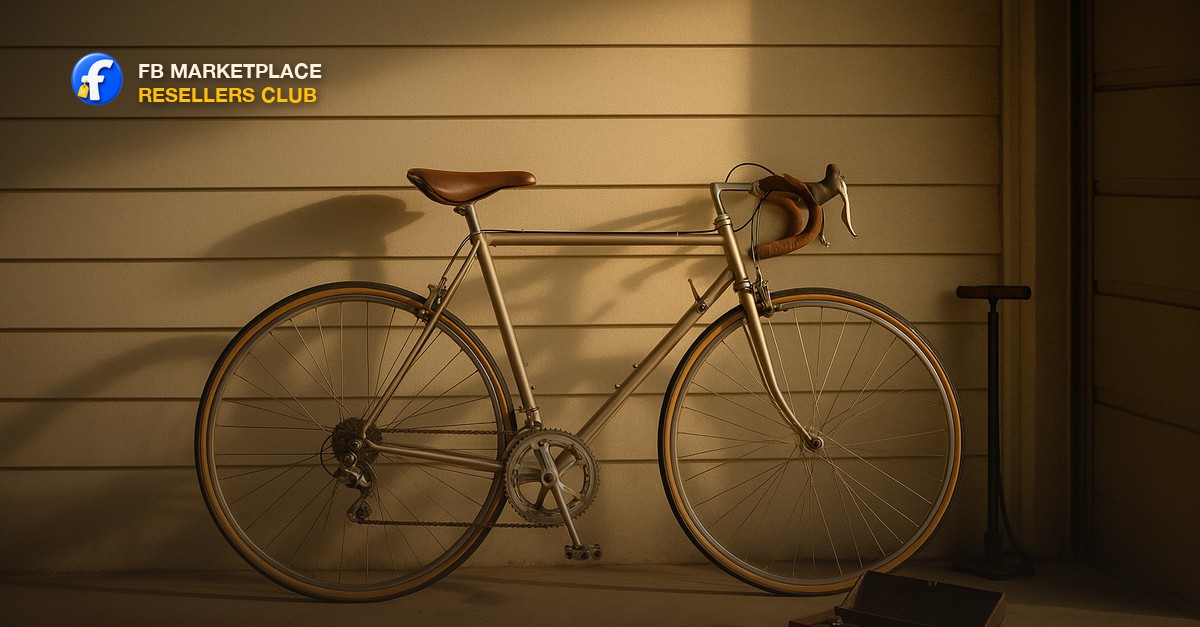
Why bikes are underpriced on Marketplace
Almost every bike listed by a household seller is priced on appearance. Dusty and flat-tyred reads as junk to them regardless of what it is, and shiny reads as valuable even when the frame is a heavy department-store special worth nothing. That gap between how a bike looks and what it actually is happens to be enormous, which is why the category rewards knowledge more than almost anything else on Marketplace.
The second reason is storage. Bikes are large, awkward, and they live in a garage annoying somebody. When the family moves or the garage gets cleared, the bike goes for whatever gets it out of the way this weekend. That motivation is the same one that makes any category profitable, but bikes combine it with a value that is genuinely hard for a non-cyclist to read.
Reading a bike in ninety seconds
You do not need to be a mechanic. You need a short checklist you run in the same order every time, standing in someone's driveway, in under two minutes. Value lives in the frame first and the components second, and everything else is a repair cost.
The ninety-second inspection
| Check | What you are looking for | What it means |
|---|---|---|
| Frame material and welds | Steel, aluminium or carbon, and clean welds rather than thick blobs | Neat welds and a named frame usually mean a real bike shop brand |
| Frame damage | Dents, cracks, rust bubbling under paint, especially near the joints | Any crack is an immediate walk-away at any price |
| Component group | The name printed on the gear mechanism and brake levers | This is the single biggest driver of resale value on a used bike |
| Wheels | Spin each one and watch it wobble side to side | Small wobble is a free fix, big wobble or dented rim is a real cost |
| Bottom bracket and headset | Grab the crank and rock it sideways; turn the handlebars slowly | Grinding or play here is the repair that most often kills the margin |
| Tyres and chain | Cracked sidewalls, rust, a chain that lifts off the front cog | Cheap consumables, but budget for them honestly |
Do the frame checks before you look at anything else. A beautiful component set on a cracked frame is worth parts money and a lot of hassle, and a plain component set on a good frame is a straightforward tune-and-flip.
The four walk-aways
Most bad bike purchases come from one of four things, and all four are visible before you hand over money. Learn these and your hit rate changes immediately.
- Any crack or serious dent in the frame. Not negotiable and not repairable at a price that makes sense. A frame that fails while someone is riding it is not a risk worth any margin.
- A seized bottom bracket or headset that will not free up. The labour and the special tools turn a cheap bike into a project, and projects are where flipping profits die.
- A department-store frame. Heavy steel, plastic fittings, a brand you only see in supermarkets. These sell for very little no matter how well you clean them, because the buyers who pay real money know the difference.
- No serial number, or a ground-off one. Bikes are among the most stolen items there are. Buying one you cannot verify puts you in a position you do not want, and it is not worth the margin on any single flip.
The tune-up that creates the margin
The profit in bikes is the gap between a filthy bike with soft tyres and a clean bike that shifts and stops properly. That gap is mostly labour and a small parts budget, and it is entirely learnable. Restoration is a different business and a worse one.
- Deep clean first, before you decide anything else. Degrease the drivetrain, wash the frame, polish it dry. Half the flaws you were worried about turn out to be dirt, and the ones that are real become visible.
- New tyres and tubes if the sidewalls are cracked. This is the cheapest upgrade with the largest effect on how the bike feels to a test rider, and a test ride is what closes the sale.
- True the wheels. Small side-to-side wobble is a spoke-key job and a genuine skill worth learning, because wheel condition is the thing buyers notice second after cleanliness.
- Adjust the gears and brakes properly. Crisp shifting is what separates a bike that feels cared for from one that feels secondhand, and it costs you cable adjustment rather than parts.
- Fresh bar tape or grips, and a clean saddle. Contact points are what the buyer touches first. Replacing them is inexpensive and disproportionately changes the impression.
- Lubricate the chain last, after everything else is done. It is the final touch that makes the bike sound right when they wheel it.
Set a hard parts budget before you buy and treat it as part of the purchase price. If the tune-up cost plus the buy price does not leave a clear margin at a realistic sale price, that is not a deal, it is a hobby. The same arithmetic discipline is covered in [how to price items on Facebook Marketplace](/blog/how-to-price-items-facebook-marketplace).
Listing a bike so it sells fast
Bike buyers search differently from other Marketplace buyers. They search by brand, by frame size and by type, which means your title has to carry all three or the right buyer never sees the listing at all.
- Put brand, model, type and frame size in the title. A listing that says road bike gets buried; one that names the brand, the model and the size gets found.
- Measure and state the frame size properly, in centimetres for road bikes and inches for mountain bikes, and add a rider height range. This single line removes most of the pointless messages.
- Photograph it outdoors against a plain wall, drive side facing the camera, in daylight. Then close-ups of the gear mechanism, the brakes and the tyres.
- Photograph any flaw deliberately and mention it. Bike buyers inspect closely and a disclosed scratch builds far more trust than a hidden one costs you.
- Say what you did to it. Fresh tyres, trued wheels, gears indexed - that sentence is the reason you can price above every other bike in the local results.
The general staging rules still apply and are worth reading alongside this: [Facebook Marketplace photo staging basics](/blog/facebook-marketplace-photo-staging-basics) covers the lighting and framing that make any item look worth more.
Meetups, test rides and getting paid
Bikes have one handover risk that furniture does not: the buyer wants to ride it, and a bike is very easy to ride away on. Handle it calmly and it is a non-issue.
- Allow test rides, but hold something of theirs - car keys or a phone - and keep the ride to a short loop you can see. Refusing a test ride costs you sales; an unsupervised one costs you the bike.
- Meet in a public place with space to ride, ideally a car park or a quiet street rather than your driveway.
- Bring a pump and a multi-tool. Adjusting the saddle height for them on the spot closes more sales than any amount of negotiating.
- Take cash and count it before they leave. The general safety approach in [Facebook Marketplace negotiation and safe meetups](/blog/facebook-marketplace-negotiation-and-safe-meetups) applies here in full.
Short, practical drops on sourcing, pricing with comps, listing copy, and safe meetups. No spam, unsubscribe anytime.
Frequently asked questions
What kind of bikes are most profitable to flip?
Bikes from real bike-shop brands with a recognisable component group, in common frame sizes, sold cheap because they are dirty rather than broken. Vintage steel road bikes and mid-range hardtail mountain bikes tend to move well because the buyer pool is wide. What to avoid is department-store bikes, which sell for very little regardless of condition, and highly specialised bikes that only a narrow set of buyers wants.
How much should I spend fixing up a bike before reselling?
Set the parts budget before you buy and treat it as part of the purchase price. Tyres, tubes, cables, bar tape and a chain are all reasonable consumables. The moment a bike needs a new wheelset, a new drivetrain or bottom bracket work you cannot do yourself, the margin is usually gone. Restoration is a different business with different economics.
How do I avoid buying a stolen bike?
Check the serial number, which is normally stamped underneath the bottom bracket where the pedal cranks meet the frame. Ask the seller how long they have owned it and whether they have any receipt or original accessories. A ground-off serial number, an evasive answer, or an unusually low price on a high-end bike are all reasons to walk. Stolen-bike registries exist and buyers do search them, so this protects you as well as them.
Do I need to be a bike mechanic to flip bikes?
No, but you need three specific skills: cleaning a drivetrain properly, adjusting gears and brakes, and truing a wheel. Those three cover the majority of what a used bike needs and all three are learnable in an afternoon each. Anything beyond that is where you should be walking away rather than learning on inventory.
What is the best time of year to flip bikes?
Buy in autumn and winter when people are clearing garages and demand is low, then sell in spring and early summer when buyers appear. That seasonal spread is one of the largest in any Marketplace category, and if you have storage space it is the easiest margin available. The tradeoff is holding inventory, so scale it to the space you actually have.
Last reviewed by Nicole on August 19, 2026