
The Short Answer
To flip appliances on Facebook Marketplace, buy working units from people who need them removed rather than sold, run a full test cycle before any money changes hands, clean them properly, and charge for delivery. Appliances carry the largest dollar spread available in local resale because most people cannot move them, cannot test them, and will not wait. Every part of the margin comes from doing the three things the average buyer will not do.
Test It Running, Every Time
The mistake that costs the most money is accepting a powered-on unit as a working unit. Lights come on, drums turn, compressors hum, and none of that tells you whether the appliance completes its job. You need a cycle, or at least enough of one to hear the machine do the thing it fails at. This takes minutes and it is the single highest-value habit in this category.
| Appliance | What to actually test | The failure that ends the deal |
|---|---|---|
| Washer | Fill, agitate, drain, and get to the spin | No spin or a loud grinding spin - transmission or bearing |
| Dryer | Heat within a few minutes, drum spins evenly | Turns but never heats, plus any burning smell |
| Fridge | Cold air at the vent and a freezer that is actually frozen | Runs constantly without cooling - compressor or sealed system |
| Dishwasher | Fills, sprays, drains, and no water under the unit | Standing water or a leak at the door seal |
| Range or oven | Every burner lights, oven reaches temperature | Dead elements or a control board that will not set |
| Microwave | Heats a cup of water in about a minute | Runs with no heat - magnetron, not worth repairing |
- Ask the seller to have it plugged in and ready before you arrive. A refusal is information, and it saves you a wasted trip.
- Bring a cup of water for microwaves and a small towel for checking under dishwashers and washers.
- Pull the washer or fridge forward and look at the floor behind it. Rust stains and water marks tell you the history the seller will not.
- Tilt a fridge that has just been moved and let it stand upright for a few hours before judging cooling. Judging too early gets you a wrong answer in both directions.
Where the Cheap Ones Come From
The best appliance buys are not from people selling appliances. They are from people who have a working unit in the way of something else: a kitchen renovation, a house sale, a tenant move-out, or a new set already delivered and sitting in the driveway. Those sellers are solving a removal problem, and the price reflects urgency rather than value.
- Renovation and new-set replacements. The old unit works fine and is now a nuisance blocking the garage.
- Moving and estate situations, where a deadline exists and everything must clear by a date.
- Free listings for working units where the only condition is that you take it today. These are the best deals in the category, and the same sourcing habits from [how to find free items to flip](/blog/how-to-find-free-items-to-flip-on-facebook-marketplace) apply directly.
- Landlords and property managers, who replace on a schedule and often have a working unit to clear each time. One relationship here can be worth more than a month of searching.
Search using the seller's language rather than the buyer's. People clearing a unit write it as needs to go, free washer working, or must be gone by Sunday. Those phrasings surface listings that never show up in a normal category browse.
Moving Them Is the Business
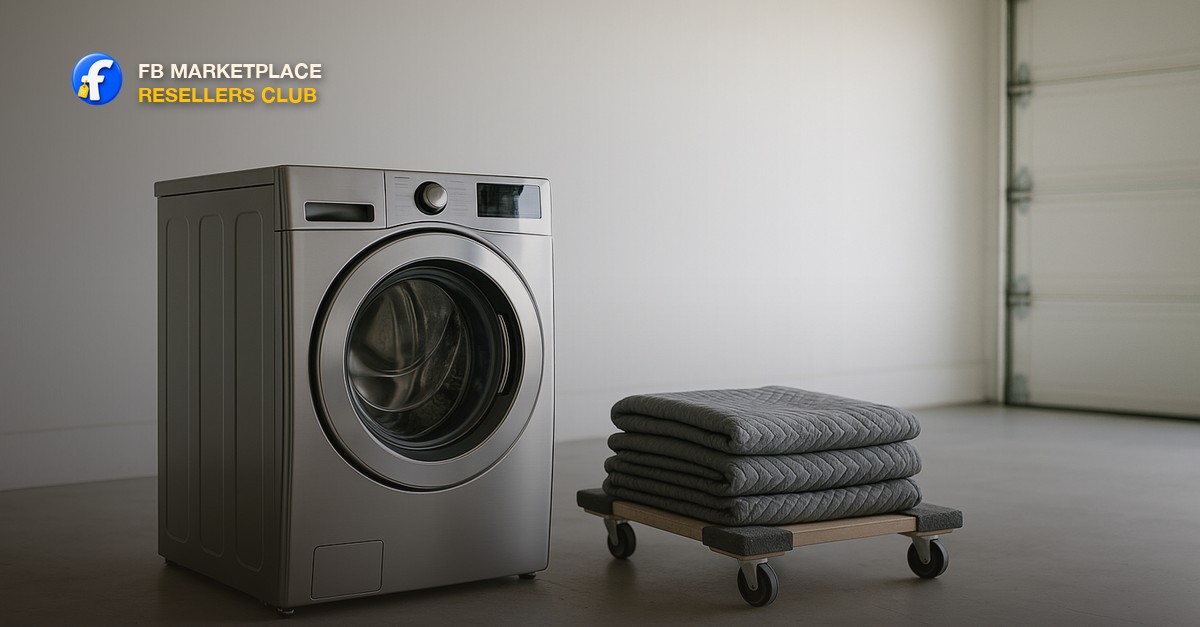
The reason this category has room in it is logistics. Most buyers cannot collect a fridge, and most sellers cannot deliver one, so whoever can do both captures the spread. Treat that as the actual service you are selling and price it separately rather than absorbing it into the item price.
- Get an appliance dolly with a strap. A furniture dolly is not the same tool and it is how units get dropped.
- Carry moving blankets and two ratchet straps. Undamaged arrival is a large part of why a buyer pays your price rather than the cheaper listing.
- Never move a unit alone if it has to go up or down stairs. One injury outweighs a year of margin in this category.
- Quote delivery as a flat local fee, stated up front in the listing. Buyers pay it readily and it removes the negotiation about whether it is included.
- Keep a second person available for the big pieces. Splitting a fee is far cheaper than the alternatives.
Cleaning and Listing So It Sells at the Top of the Range
Appliances are the category where cleaning changes the number most. Buyers are picturing this object in their kitchen, and a unit that smells faintly of someone else's house sells for a fraction of an identical one that looks and smells like nothing. An hour of work is routinely the difference between the bottom and the top of the local price range.
- Pull the drawers, shelves, and filters and wash them separately. The detail buyers notice is inside, not outside.
- Deal with smell properly rather than covering it. An unresolved odour in a fridge is the fastest route to a return conversation.
- Photograph it plugged in and running, with the display lit. A photo of the working control panel does more than any sentence in the description.
- Include the model number in the listing text. Buyers search for specific models, and it makes the listing findable in a way a generic title is not.
- Say plainly what is not perfect. A named small dent on the side gets you a buyer who arrives prepared instead of one who renegotiates in the driveway.
Write the description as a physical account of the object and its condition rather than a pitch, which also keeps you clear of the listing problems covered in [why your listing was rejected](/blog/facebook-marketplace-listing-rejected-what-to-do).
The Units to Walk Away From
Discipline about what you do not buy matters more in appliances than in any other category, because the losses are large and slow. A bad piece of furniture is fifty dollars and a wasted afternoon. A bad fridge is a heavy object you now have to pay someone to remove.
- A fridge that runs constantly without cooling. Sealed-system work is not economical at resale prices.
- A washer that will not spin or grinds through the spin cycle. Assume the expensive diagnosis.
- Any front-load washer with mould around the door seal that has soaked into the drum area. The smell comes back.
- Anything with visible water damage to the base, or heavy rust on the cabinet. Both indicate the unit sat somewhere wet.
- Very old units in styles nobody wants. Working is not the same as sellable, and a unit that sits for two months has cost you space and cash flow.
- Built-in and integrated units unless you have a specific buyer. The installation requirement shrinks the buyer pool dramatically.
Also be honest about capital. This category ties up more money per item than most, so if you are working from a small starting float, appliances can absorb it quickly - the maths in [how much money to start flipping](/blog/how-much-money-to-start-flipping-facebook-marketplace) is worth checking before you commit to a set.
Short, practical drops on sourcing, pricing with comps, listing copy, and safe meetups. No spam, unsubscribe anytime.
Frequently asked questions
Are appliances profitable to flip on Facebook Marketplace?
They carry the largest dollar spread available in local resale, and also the largest downside. The margin exists because most buyers cannot move a fridge, most sellers cannot deliver one, and few people test properly. Do all three and the numbers are strong. Skip the testing and one dead compressor removes the profit from several good flips.
How do I test a used washer or fridge before buying?
Run a real cycle rather than checking that it powers on. A washer needs to fill, agitate, drain, and reach the spin, since no spin usually means expensive work. A fridge needs cold air at the vent and a genuinely frozen freezer, not just a running compressor. Ask the seller to have the unit plugged in before you arrive.
Which appliances should I avoid buying to resell?
Any fridge running constantly without cooling, any washer that will not spin or grinds through the cycle, front-loaders with mould soaked into the door seal area, units with rust or water damage at the base, and built-in models that need installation. Working is also not the same as sellable, so avoid very old units in styles no local buyer wants.
Where do the cheap working appliances come from?
From people solving a removal problem rather than selling an appliance: kitchen renovations, new sets already delivered, house sales, tenant move-outs, and landlords replacing on a schedule. Search the seller's phrasing, such as needs to go or must be gone, since those listings rarely surface in a normal category browse.
Should I charge for appliance delivery?
Yes, as a flat local fee stated in the listing. Delivery is the actual service most buyers are short of, so pricing it separately gets paid readily and stops the negotiation about whether it was included. Offering to haul away the buyer's old unit for a small extra fee also means getting paid to collect your next piece of inventory.
How much does cleaning affect the sale price?
More than in any other category. Buyers are imagining the unit in their own kitchen, so an identical appliance that looks and smells like nothing sells at the top of the local range while a faintly smelly one sits at the bottom. Pull the shelves, drawers, and filters and wash them separately, and resolve odours rather than masking them.
Last reviewed by Nicole on August 17, 2026